What makes cacao “ceremonial”?
Why do prices vary so widely?
And how can you tell whether what you’re buying is genuinely high quality?
This guide focuses on practical clarity, not hype. It explores what ceremonial cacao usually refers to, what qualities tend to matter most, and how to make a grounded choice that fits your lifestyle and intentions.
Ceremonial cacao isn’t a legally protected term. There’s no global certification that officially labels cacao as ceremonial.
Instead, the term is generally used to describe cacao that:
In practice, ceremonial cacao sits closer to food and ritual than to supplements or sweets.
Understanding this helps cut through marketing language and focus on what actually matters.
Because “ceremonial” isn’t regulated, quality varies significantly.
Two cacao blocks may both carry the same label, yet differ greatly in:
High-quality ceremonial cacao tends to feel clean, grounding, and nourishing, while lower-quality versions may feel heavy, bitter, or overly stimulating.
Learning how to recognize quality helps you choose cacao that supports presence rather than discomfort.
The simplest check is often the most revealing.
High-quality ceremonial cacao usually contains:
That’s it.
No added sugar.
No milk solids.
No flavouring agents.
No emulsifiers.
The more ingredients added, the further the product moves away from traditional ceremonial use.
Ceremonial cacao is typically made by:
This method keeps the natural cacao butter intact, which contributes to:
Highly industrialized processing often strips cacao of these qualities.
When possible, look for brands that share how their cacao is processed — transparency often signals care.
Cacao is deeply influenced by where it’s grown.
High-quality ceremonial cacao is often:
This doesn’t guarantee a better experience — but it does increase the likelihood of freshness and ethical sourcing.
Ceremonial cacao doesn’t taste like sweet chocolate.
Its flavour may be:
What it usually isn’t is burnt, chalky, or overwhelmingly harsh.
A balanced taste often reflects careful fermentation and gentle processing.
High-quality ceremonial cacao:
If the cacao looks dusty, dry, or overly matte, it may be defatted or old.
Texture matters because it affects how cacao is absorbed and experienced in the body.
Ceremonial cacao is often described as energizing — but not in the sharp way coffee can be.
Many people notice that high-quality cacao:
Low-quality cacao may feel overwhelming or cause digestive discomfort.
Quality isn’t only sensory — it’s relational.
High-quality ceremonial cacao is often:
Ethics may not change the taste immediately, but they do shape the integrity of the product.
Cacao is a living food. Over time, it can lose aroma and vitality.
When choosing ceremonial cacao, consider:
Be cautious of claims like:
High-quality cacao doesn’t need dramatic promises.
The right ceremonial cacao depends on:
Ceremonial cacao doesn’t fix or transform on its own.
It’s often used as:
Choosing high-quality ceremonial cacao is less about finding something extraordinary and more about recognizing what’s clean, honest, and well cared for.
At conscious collective, our ceremonial cacao is sourced and prepared with simplicity and respect — offered as a ritual companion rather than a promise.
You’re welcome to explore our offerings when it feels aligned.
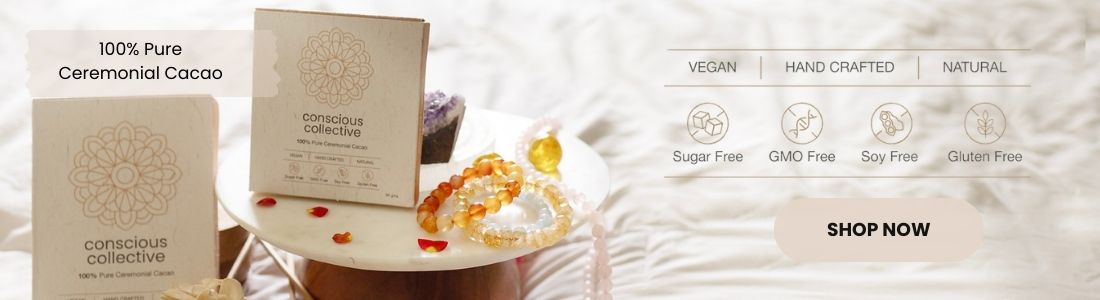
Our offerings—ceremonial cacao, crystals, candles, and journals—are designed to support mindfulness, self-connection, and sacred daily rituals. Every product is ethically sourced, handcrafted with care, and infused with meaning to help you slow down, tune in, and create moments of presence.
© 2025 All rights reserved Conscious Collective