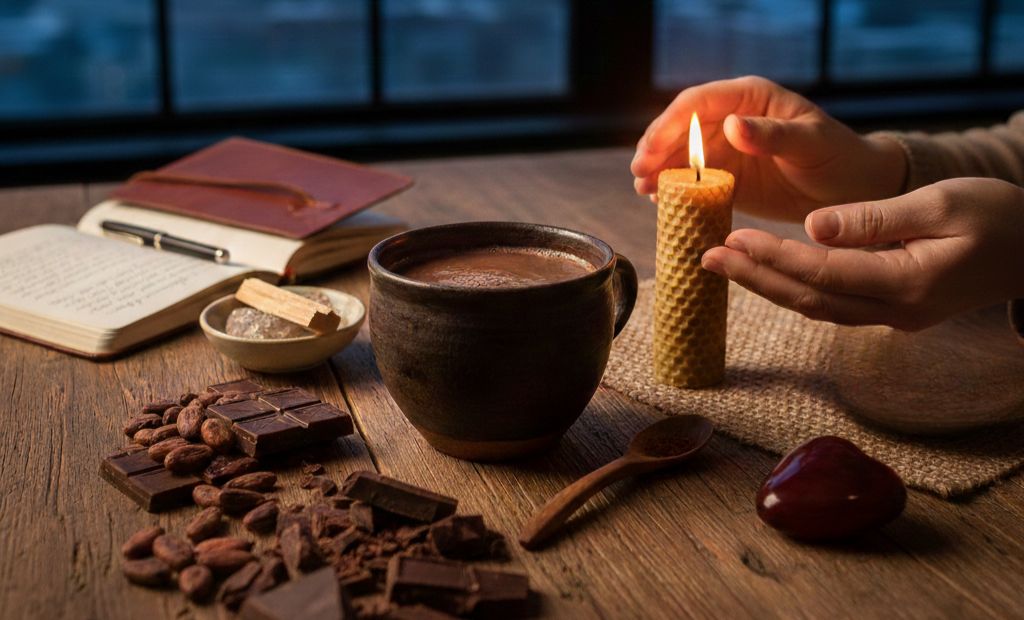
Many rituals begin with clear intention — a word, a wish, a focus for the day. Yet intention alone doesn’t always translate into felt experience. The body moves at a different pace than the mind.
This is where cacao can play a supportive role. Not as something that promises a particular outcome, but as a sensory ally that may help the body slow down enough to notice what’s already present.
From Thinking to Sensing
Intention lives in language.
The body responds to sensation.
Warmth in the hands, the taste of cacao, the pause between sips — these small physical cues can help shift awareness out of thought and into the body. For some people, this makes ritual feel more grounded and accessible, especially in everyday settings.
Why Simplicity Matters
Rituals that include too many steps or expectations can keep attention in “doing” mode. Simpler rituals often land more easily.
Elements that tend to support embodiment include:
- a familiar cup or setting
- unhurried pacing
- repeated use of the same ritual structure
- space for silence
Cacao doesn’t need to be the centrepiece. It can simply support the transition into presence.
Allowing the Body to Set the Pace
Every experience with cacao can feel different. Some days it may feel grounding, other days barely noticeable. This variability is normal.
Designing rituals that land in the body means allowing flexibility — adjusting quantity, timing, or even choosing not to drink cacao at all when it doesn’t feel supportive.
Listening is part of the practice.
Where Ritual Meets Integration
When a ritual truly lands, its effects often show up quietly afterward — as steadier energy, clearer boundaries, or a slightly slower rhythm through the day.
These small shifts tend to build over time, not through intensity, but through consistency and care.
A Gentle Invitation
If you’re exploring cacao as part of your ritual practice, working with pure, consciously sourced ceremonial cacao can support a more intentional experience.
At Conscious Collective, our ceremonial cacao is offered with respect for the plant and the people behind it — for those who wish to design rituals that feel grounded, embodied, and simple.
You’re welcome to explore it in your own time and in your own way.
Sacred Objects, Sacred Attention: The Role of Tools in Modern Ritual
Here’s a concise, informative, and grounded blog — reflective without sounding absolute, and written for modern, real-life ritual practice.
Sacred Objects, Sacred Attention: The Role of Tools in Modern Ritual
Ritual has always involved objects — cups, stones, symbols, vessels. Not because the objects themselves were sacred, but because they helped focus attention.
In modern life, where attention is constantly pulled in different directions, tools can still play a meaningful role. When used intentionally, they may help create small pauses — moments where awareness gathers instead of scatters.
Why Objects Matter in Ritual
The body responds to what is tangible. Weight, texture, temperature, and placement offer sensory cues that signal this moment is different.
A cup used only for cacao.
A crystal kept in one specific place.
A candle lit at the same time each evening.
These objects can help mark the transition from ordinary activity into intentional presence.
Tools as Anchors, Not Sources of Power
It’s easy to place too much meaning on ritual tools — to see them as the source of change. In practice, tools work best as anchors, not authorities.
They don’t create focus or safety on their own. Instead, they support the body in remembering how to slow down, how to pause, how to return.
The power of a ritual tool comes from repetition and relationship, not belief.
Choosing Tools That Support Presence
Ritual tools don’t need to be rare or elaborate. What often matters more is how consistently they’re used and how much space they’re given.
Simple questions can help guide choice:
- Does this object invite me to slow down?
- Does it feel grounding rather than distracting?
- Can I return to it easily, without effort?
When a tool feels heavy, obligatory, or performative, it may be time to simplify.
Ritual in a Modern Context
Modern ritual often needs to fit into busy lives. Short practices, repeated regularly, tend to be more sustainable than elaborate ceremonies.
A single object used with care can hold more meaning than many used occasionally. Over time, this consistency may help build a sense of rhythm — something many people quietly crave.
Sacredness Is Created Through Attention
Objects don’t make a ritual sacred.
Attention does.
Tools simply hold the place where attention gathers.
If you’re drawn to working with ritual tools — whether cacao vessels, crystals, or other objects — choosing pieces that are thoughtfully sourced and intentionally offered can support a more grounded relationship.
At Conscious Collective, our offerings are shared as ritual companions — not as promises or prescriptions — for those who wish to bring more presence into everyday life, gently and honestly.
You’re welcome to explore them when it feels aligned.