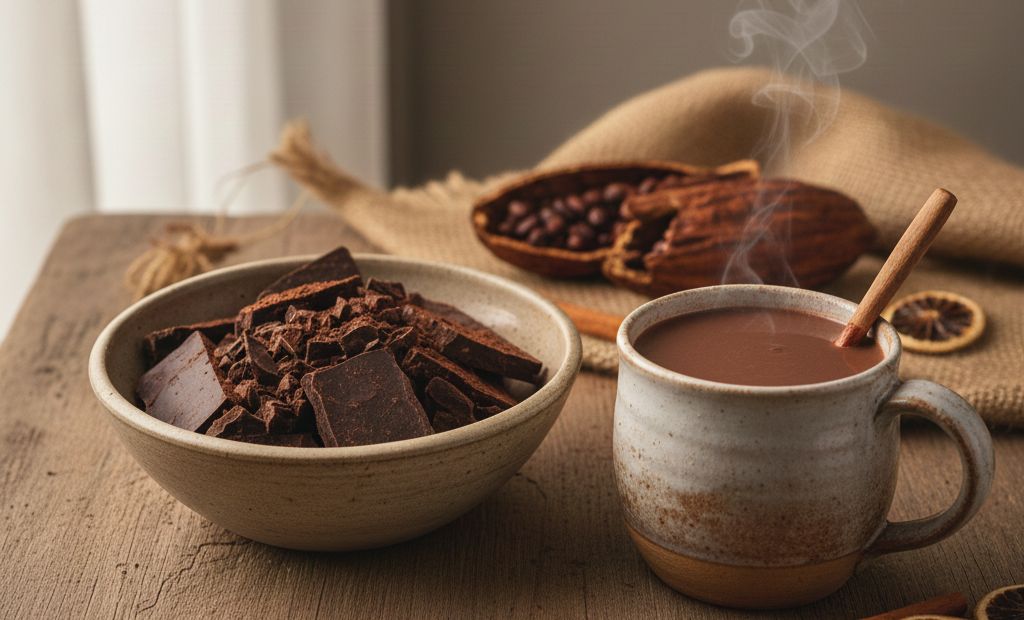
the price difference can feel surprising. This often leads to a reasonable question:
why is ceremonial cacao expensive, and what are you actually paying for?
This blog explores the real factors behind the cost of ceremonial cacao — from sourcing
and processing to ethics and quality — so you can make an informed, grounded decision
without hype or pressure.
What Makes Ceremonial Cacao Different
Ceremonial cacao is not the same product as commercial cocoa.
While both come from cacao beans, the way they are grown, processed,
and handled differs significantly.
Ceremonial cacao is typically:
- Minimally processed
- Made from whole cacao beans (not just cocoa solids)
- Prepared in small batches
- Sourced with attention to tradition and ethics
These differences directly affect cost.
1. Quality of Cacao Beans
The first factor influencing price is bean quality.
Ceremonial cacao is usually made from:
- Heirloom or native cacao varieties
- Beans grown for flavour and integrity, not yield
- Cacao harvested at peak ripeness
In contrast, commercial cocoa often uses high-yield hybrid varieties bred for volume,
not quality. These beans are cheaper to produce but lack the complexity and nutritional
integrity many people seek in ceremonial cacao.
Higher-quality beans cost more because they take longer to grow,
produce lower yields, and require more careful harvesting.
2. Small-Scale and Ethical Farming Practices
Much ceremonial cacao is sourced from small-scale farmers or cooperatives
rather than large industrial plantations.
- Grown alongside other crops
- Avoidance of harmful chemical inputs
- Use of traditional or regenerative practices
- Fair compensation for farmers
Paying farmers fairly increases cost — but it also supports long-term sustainability
and community well-being.
Cheap cacao often relies on underpaid labour, exploitative supply chains,
and large-scale monoculture farming. Ceremonial cacao tends to prioritise
relationship over extraction.
3. Minimal Processing (Which Costs More)
Commercial cocoa is heavily processed to increase shelf life and reduce costs.
Beans are often roasted at high temperatures, alkalised, stripped of natural fats,
and combined with additives.
Ceremonial cacao is usually lightly roasted or stone-ground,
not alkalised, and kept as close to the whole bean as possible.
Minimal processing preserves more of cacao’s natural compounds —
but it is slower, more labour-intensive, and less efficient at scale.
Less processing does not mean less work. It often means more care.
4. Whole-Bean Composition
Ceremonial cacao is made from the entire cacao bean, including the cacao butter.
Cacao butter contributes to nutrition, texture, and flavour —
and it is one of the most valuable components of cacao.
In commercial production, cacao butter is often removed and sold separately.
Keeping it in the final product increases cost but preserves the integrity of the cacao.
5. Smaller Batch Production
Ceremonial cacao is rarely mass-produced.
- Higher labour costs per unit
- Slower production timelines
- Hands-on quality control
Large manufacturers reduce costs through volume.
Small producers absorb higher per-unit expenses to maintain quality and intention.
6. Sourcing Transparency and Traceability
Ceremonial cacao often comes with a clear understanding of
where it was grown, who harvested it, and how it was processed.
Maintaining transparent supply chains requires direct trade relationships,
consistent communication, and accountability — all of which add cost.
When cacao is very cheap, its origins are often unclear.
7. Labour Beyond the Farm
The cost of ceremonial cacao extends beyond farming.
- Careful sorting and fermentation
- Slow grinding and preparation
- Small-batch packaging
- Freshness-focused storage
These processes rely on human labour rather than automation.
When labour is valued and fairly compensated, the final product reflects that.
8. Storage and Freshness
Ceremonial cacao is sensitive to temperature, moisture, and time.
Proper storage and climate-aware shipping add cost.
Unlike commercial cocoa powder, ceremonial cacao is not designed
to sit on shelves indefinitely.
9. What You’re Not Paying For
Ceremonial cacao typically does not prioritise:
- Artificial flavouring
- Cost-cutting additives
- Mass-market distribution
- Excessive branding markups
Much of the cost goes toward the product itself and the people behind it.
Is Ceremonial Cacao Worth the Cost?
Whether ceremonial cacao feels worth it depends on how you plan to use it.
For those approaching cacao as a ritual companion,
a seasonal practice, or an intentional addition rather than a daily stimulant,
quality often matters more than quantity.
Ceremonial cacao is not meant to replace coffee or chocolate.
It represents a different kind of relationship.
Choosing Ceremonial Cacao Mindfully
When selecting ceremonial cacao, it may help to look for transparent sourcing,
minimal ingredient lists, clear preparation guidance,
and respectful language around use.
Price alone doesn’t guarantee integrity — but extremely low prices
often indicate compromises somewhere in the supply chain.
A Thoughtful Closing
Ceremonial cacao is expensive because it carries more than cacao solids.
It reflects time, labour, tradition, and care —
from the soil it grows in to the hands that prepare it.
At conscious collective, our ceremonial cacao is offered with attention
to sourcing, processing, and relationship —
for those who wish to work with cacao slowly, intentionally,
and with respect for its origins.
You’re welcome to explore it if and when it feels aligned.