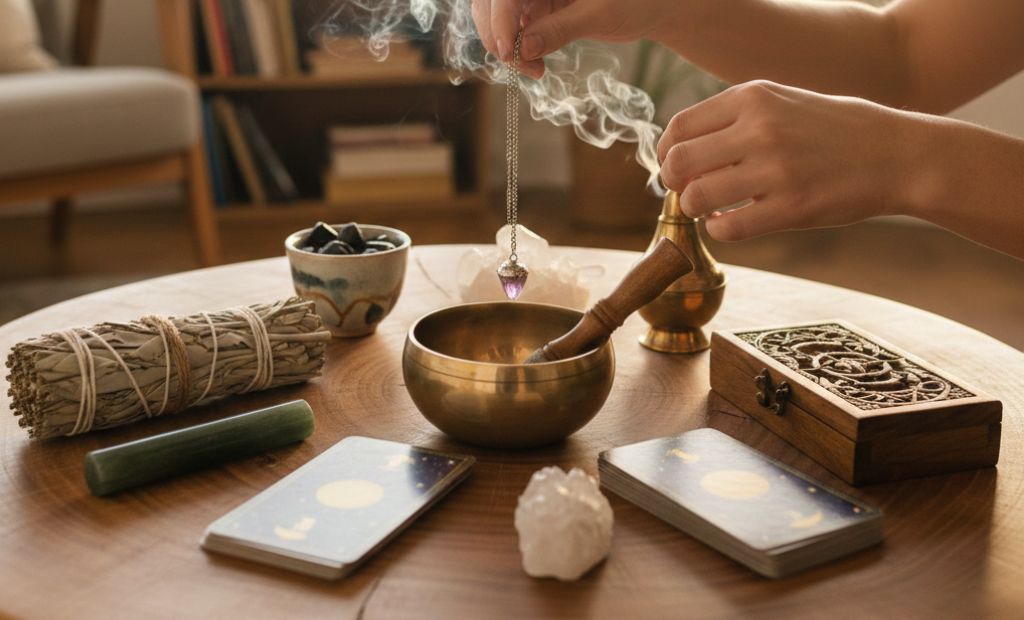
Across cultures and time, physical objects have always played a role — cups, bowls, beads, stones, candles. Not because the objects themselves held magic, but because they helped gather attention.
In a world where attention is constantly divided, tangible tools can still serve this purpose. They give the mind and body something to orient around — a physical point that signals: this moment is different.
Why the Body Responds to Objects
The nervous system understands sensation more quickly than language. Texture, weight, temperature, and shape all offer subtle cues that help the body register presence.
Holding a warm mug.
Touching a smooth stone.
Lighting a candle and watching the flame steady.
These small sensory experiences can help shift awareness out of mental noise and into the present moment. The object becomes a bridge — not between worlds, but between thinking and sensing.
Objects Mark Transitions
One of the quiet functions of ritual tools is that they help mark the movement from one state to another.
A cup used only for evening tea may signal the end of the workday.
A mat unrolled in the morning may signal time to check in with the body.
A crystal placed on a bedside table may mark the transition toward rest.
Over time, repetition builds association. The body begins to recognise the object as a cue: it’s safe to slow down now.
This is less about symbolism and more about pattern.
Tools as Anchors, Not Authorities
It’s easy to slip into believing an object is the source of calm, clarity, or grounding. In reality, tools tend to work best as anchors for attention rather than containers of power.
They don’t create presence.
They hold a place where presence can land.
When a tool is treated as a support rather than a solution, the relationship stays balanced. The focus remains on the practice itself — breathing, noticing, pausing — rather than on collecting or perfecting objects.
Choosing Objects That Support Rather Than Distract
Modern ritual doesn’t require elaborate altars or rare items. Often, simpler objects create a stronger sense of steadiness because they’re easy to return to.
It can help to ask:
- Does this object make me feel more grounded or more stimulated?
- Is it easy to include in my daily life?
- Does it invite me to pause, even briefly?
If an item starts to feel performative, cluttered, or emotionally loaded, it may no longer be serving its purpose. Ritual tools are meant to support attention, not compete for it.
Everyday Ritual in a Busy World
For many people, ritual now happens between meetings, after long commutes, or in the quiet minutes before sleep. In this context, tools that are simple and portable often work best.
A single stone in a pocket.
A cup used with care each morning.
A candle lit for five minutes at dusk.
Small, consistent gestures tend to shape the nervous system more gently than occasional elaborate ceremonies.
Sacredness Comes From Attention
Objects themselves are neutral. What changes their role is the quality of attention brought to them.
When attention gathers, a simple cup can feel significant.
Without attention, even the most carefully chosen tool becomes decoration.
Sacredness, in this sense, is not something an object contains — it’s something we practice.
A Gentle Invitation
If you feel drawn to working with ritual tools — whether cups, crystals, or other meaningful objects — choosing pieces that are thoughtfully sourced and intentionally offered can support a more grounded relationship with them.
At Conscious Collective, our offerings are shared as companions for everyday ritual: simple objects meant to support moments of presence, not prescribe how those moments should look.
You’re welcome to explore what feels supportive, in your own time and in your own way.