Introduction: The Heart Remembers What the Mind Forgets
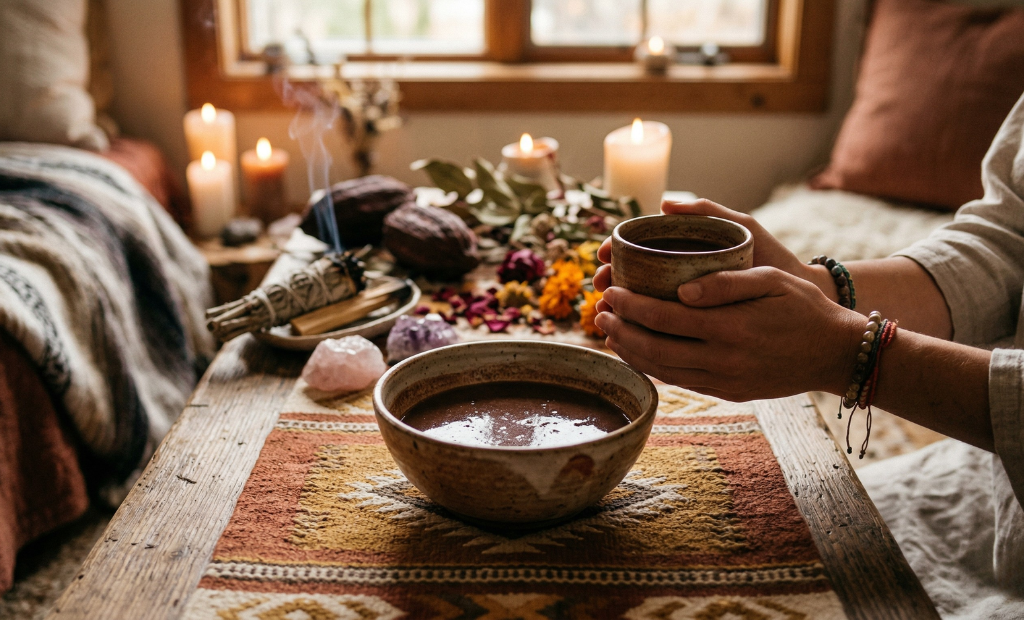
There is something unmistakable that happens in a cacao ceremony. The cup is warm in your hands, the scent is earthy and deep, and somewhere between the first sip and the opening meditation, something shifts. A memory surfaces. A feeling you haven’t touched in years quietly announces itself. Maybe it’s grief. Maybe it’s love. Maybe it’s a wordless ache you’ve been carrying so long you forgot it had a name.
This isn’t coincidence. And it isn’t magic — at least not the kind that bypasses biology. The reason cacao ceremony so consistently invites emotional memory to the surface lies at the intersection of plant chemistry, nervous system physiology, and the ancient wisdom of intentional ritual. Understanding why this happens can help you approach your next ceremony with more trust, more openness, and more compassion for whatever arises.
What Is Ceremonial Cacao?
Before we explore the emotional landscape of cacao ceremony, it helps to understand what ceremonial cacao actually is — and how it differs from the chocolate bar on your grocery shelf.
Ceremonial cacao is made from whole, minimally processed cacao beans, typically sourced from indigenous farming communities in Central and South America, particularly Guatemala, Peru, and Ecuador. Unlike commercial chocolate, which strips away much of the cacao’s nutritional and psychoactive compounds during processing, ceremonial cacao retains its full spectrum of active constituents.
Key among these are theobromine, a gentle cardiovascular stimulant that opens blood vessels and increases blood flow to the heart and brain; anandamide, sometimes called the “”bliss molecule,”” a naturally occurring endocannabinoid that influences mood and emotional regulation; phenylethylamine (PEA), associated with feelings of love and emotional connection; and magnesium, which supports nervous system relaxation and muscle release. Together, these compounds create a subtle but powerful physiological environment that makes the heart more receptive — not just metaphorically, but literally.
The Neuroscience of Emotional Memory
To understand why emotions surface in cacao ceremony, we need to briefly visit how emotional memory works in the brain.
Emotional memories are not stored the same way factual memories are. While you might recall the date of a historical event through cognitive recall, emotional memories — particularly those tied to intense experiences — are encoded in the amygdala and the limbic system, the older, more primal regions of the brain. These memories are often stored as sensations, body feelings, and emotional tones rather than clear narratives.
This is why emotional memories can be triggered by smell, touch, music, or atmosphere rather than by conscious thought. The limbic system doesn’t respond to logic — it responds to resonance. When the conditions in your body and environment match the emotional “”signature”” of a stored memory, that memory can surface unbidden.
Cacao creates the physiological conditions that lower the threshold between stored emotional experience and conscious awareness. The increased heart rate variability, the vasodilation, the mild euphoria from anandamide — all of these shift your nervous system in ways that make emotional memory more accessible.
The Role of the Heart in Emotional Memory
In many indigenous traditions, cacao is called a “”heart opener”” — and this language is more literal than we might assume. The heart has its own neural network, often referred to as the “”heart brain.”” Research in the field of neurocardiology has shown that the heart sends more signals to the brain than the brain sends to the heart, and that these signals can influence emotional processing, perception, and memory recall.
Theobromine in ceremonial cacao directly supports cardiovascular function, gently increasing circulation and heart rate in a way that heightens heart-brain communication. This can create a state of increased emotional sensitivity and openness — a physiological environment where feelings that normally live beneath the surface of daily awareness become perceptible.
When we speak of the heart opening in ceremony, we are talking about this very real shift in how information — including emotional memory — flows between the heart and the mind.
Why Specific Emotions Surface
One of the most common questions people have after a cacao ceremony is: why did that particular emotion come up? Why grief, when my life feels mostly fine? Why joy, when I’ve been stressed? Why did I suddenly think about my grandmother, or my childhood bedroom, or a relationship that ended years ago?
The answer lies in what the body has been holding. Modern life is extraordinarily efficient at suppressing emotional experience. We are conditioned from childhood to move quickly past difficult feelings, to be productive, to keep up. The result is that many emotional experiences — especially those that felt unsafe or inconvenient to fully process at the time — get stored in the body as unresolved tension, incomplete grief, suppressed joy, or unfelt rage.
Cacao ceremony creates a rare combination of physiological safety (the body feels open, warm, supported), environmental invitation (the ritual container gives permission to feel), and neurochemical openness (the compounds in cacao lower the threshold of emotional access). In this state, the body takes the opportunity to surface what it has been quietly holding, inviting completion, integration, or simply acknowledgment.
The emotion that surfaces is usually not random. It tends to be what the body has been waiting to feel.
The Importance of Set, Setting, and Intention
Cacao doesn’t force emotional experiences — it creates conditions. The specific emotions and memories that surface in ceremony are also significantly shaped by set (your mindset and intention coming into the space) and setting (the environment, facilitation, and ritual structure of the ceremony itself).
A well-held cacao ceremony creates a container of safety — one where emotional experience is normalized rather than pathologized, where silence is honored as much as sharing, and where the facilitator holds space without directing what participants should feel. This matters enormously. The nervous system will not release what it has been storing unless it feels genuinely safe to do so.
This is why the quality of facilitation in cacao ceremony is so important. When the space is held with skill, reverence, and psychological understanding, the cacao can do its work. When it isn’t, participants may feel activated but unsupported — which is why choosing your ceremony space carefully is a meaningful act of self-care.
Integration: What to Do With What Surfaces
Emotional memory arising in ceremony is not the destination — it is an invitation. The real work happens in what you do with the experience afterward.
Integration is the process of making meaning from what arose, allowing it to inform your life rather than simply adding it to your collection of peak experiences. This might look like journaling about what surfaced, working with a therapist or somatic practitioner, creating art, spending time in nature, or simply allowing yourself the space to be with the feeling until it moves through.
Some emotions that surface in cacao ceremony may be connected to deeper patterns that benefit from professional support, especially if you have a history of trauma. Cacao is a powerful ally, but it works best as part of a broader commitment to emotional health and self-awareness.
Conclusion: Trust the Intelligence of Your Body
Cacao ceremony has been practiced for thousands of years across Mesoamerican cultures not because it produces pleasant feelings on demand, but because it facilitates a quality of inner listening that daily life rarely allows. The emotions and memories that surface in ceremony are not interruptions to the experience — they are the experience.
When you bring a cup of ceremonial cacao to your lips in a sacred context, you are offering your body an invitation: to be heard. What it brings forward in response is an act of intelligence, not malfunction. Learning to receive that intelligence — with curiosity, compassion, and patience — is the practice that cacao ceremony truly teaches.