Mornings tend to get all the attention when people talk about rituals. There are countless guides on how to start the day with intention, how to sip cacao before the world wakes up and how to sit with a japmala before the first notification arrives. But the evening may hold just as much potential for presence. If a morning ritual can set the tone for the day, an evening ritual may help the body understand that the day is actually over.
For many people, the day does not end so much as it fades. Work bleeds into dinner. Dinner bleeds into scrolling. Scrolling bleeds into sleep, which often does not feel like rest at all. Without a clear signal, the nervous system may stay in a low simmer of alertness long after the actual tasks are done. This is where a closing ritual can quietly do its work.
Why the Body May Need a Signal to Stop
The human nervous system tends to respond to cues rather than clocks. A calendar can say the workday ends at six, but the body may not agree unless something tells it so. Light, sound, touch and scent can all act as signals that shift the body from a state of doing into a state of being. This may be part of why so many cultures built evening customs around fire, water or quiet repetition. These were not simply nice traditions. They may have served as a kind of internal switch.
When there is no ritual to mark the transition, the mind can carry the day’s tasks straight into the pillow. Thoughts about tomorrow’s meeting or an unanswered message may keep circulating well past midnight. A wind down ritual, however small, may offer the mind a place to set these things down.
What an Evening Ritual Could Look Like
There is no single correct way to close a day. The idea is less about performing a perfect sequence and more about creating a repeatable cue that tells the body it is safe to slow down. A few simple elements that people often turn to include the following.
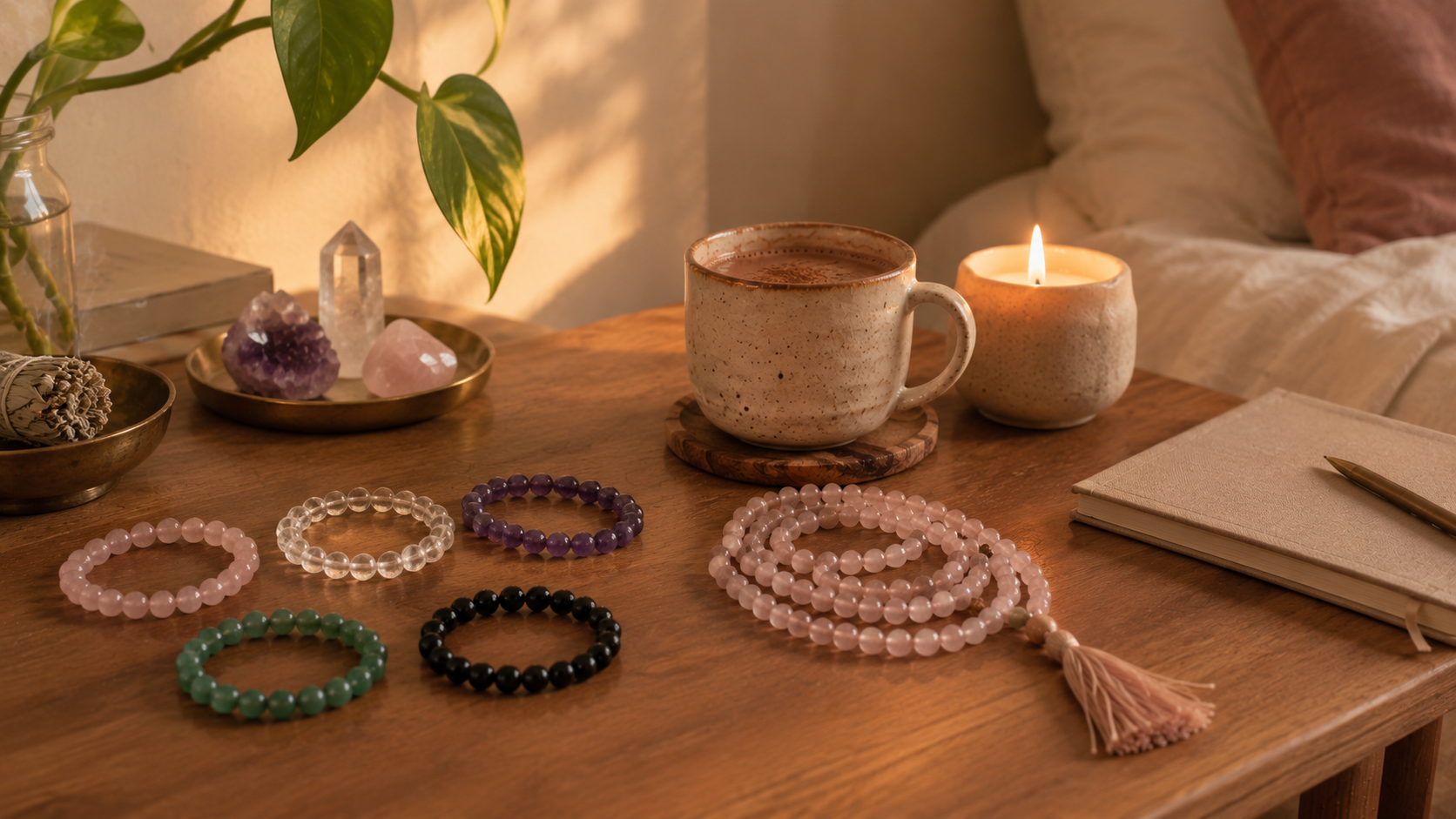
A cup of cacao, but slower. Where a morning cacao may be about awakening the senses, an evening cup can be approached differently. A smaller amount, prepared without rush, sipped somewhere quiet may help mark the boundary between the outside world and home. Some people like to sit with it in silence for a few minutes before speaking to anyone or checking a screen.
A single flame. Lighting a tealight or a stick of incense at the end of the day can act as a bookend to whatever was lit that morning. There may be something grounding about watching a small flame rather than a bright screen. The light is soft, contained and does not ask anything of you.
Counting down with a japmala. A short round on a japmala, even just twenty seven or fifty four beads instead of the full one hundred and eight, can offer the hands something to do while the mind slows. The repetition may help interrupt the loop of replaying the day’s events.
A few minutes of stillness before speaking. Some people find it helpful to sit quietly for a short while before engaging in conversation with a partner or roommate. This pause may create space to notice what the day left behind before adding new input on top of it.
None of these need to take more than ten minutes. The point is not the length but the consistency. A ritual repeated nightly, even briefly, may become a stronger cue over time than an elaborate one done occasionally.
Matching the Ritual to the Kind of Day
Not every evening calls for the same closing. A day that felt scattered may benefit from something slower and quieter, perhaps a longer sit with cacao and a single candle. A day that felt heavy emotionally may call for something gentler, like simply holding a crystal or a bracelet without any particular technique attached to it. There does not need to be a fixed formula. Paying attention to what the body seems to want on a given evening may be part of the practice itself.
Some people also like to use the ritual as a moment of reflection, silently naming one thing that went well and one thing they are ready to release. This does not need to be written down or spoken aloud. It can simply be a private acknowledgment, something that may help close a mental loop before sleep.
Why This May Matter More in a Remote or Hybrid World
For people working from home, the line between work life and home life can blur in ways that did not exist when a commute physically separated the two. Without a train ride or a walk to create distance, the laptop closing may not feel like enough on its own. An evening ritual can offer a substitute for that lost transition, something the body can learn to associate with the day actually being finished.
Even a short walk to another room to light incense, or a few minutes on the balcony with a warm cup, may help create the sense of leaving work behind that used to happen automatically.
Starting Small
If evening rituals are new territory, there is no need to build a full practice overnight. Choosing one small anchor, perhaps a candle lit each night at the same time, may be enough of a start. Over a few weeks, the body may begin to associate that flame with permission to slow down.
Over time, more elements can be added if they feel meaningful, or the ritual can stay exactly as simple as it began. What matters may be less about what is included and more about the fact that something marks the close of the day, night after night, so the body eventually learns to trust that rest is coming.
A day that opens with intention and closes with a small pause may feel more whole than one that simply runs until exhaustion takes over. The evening does not need a grand ceremony. It may just need a moment, however brief, to say that this part is done.