A japmala is often described as a counting tool, something used to keep track of repetitions during a chant or a breath practice. But for many people who use one regularly, the counting itself may end up mattering less than what happens around it. The real practice may not be about reaching one hundred and eight. It may be about what the mind does each time it drifts and has to come back.
The Bead as a Point of Return
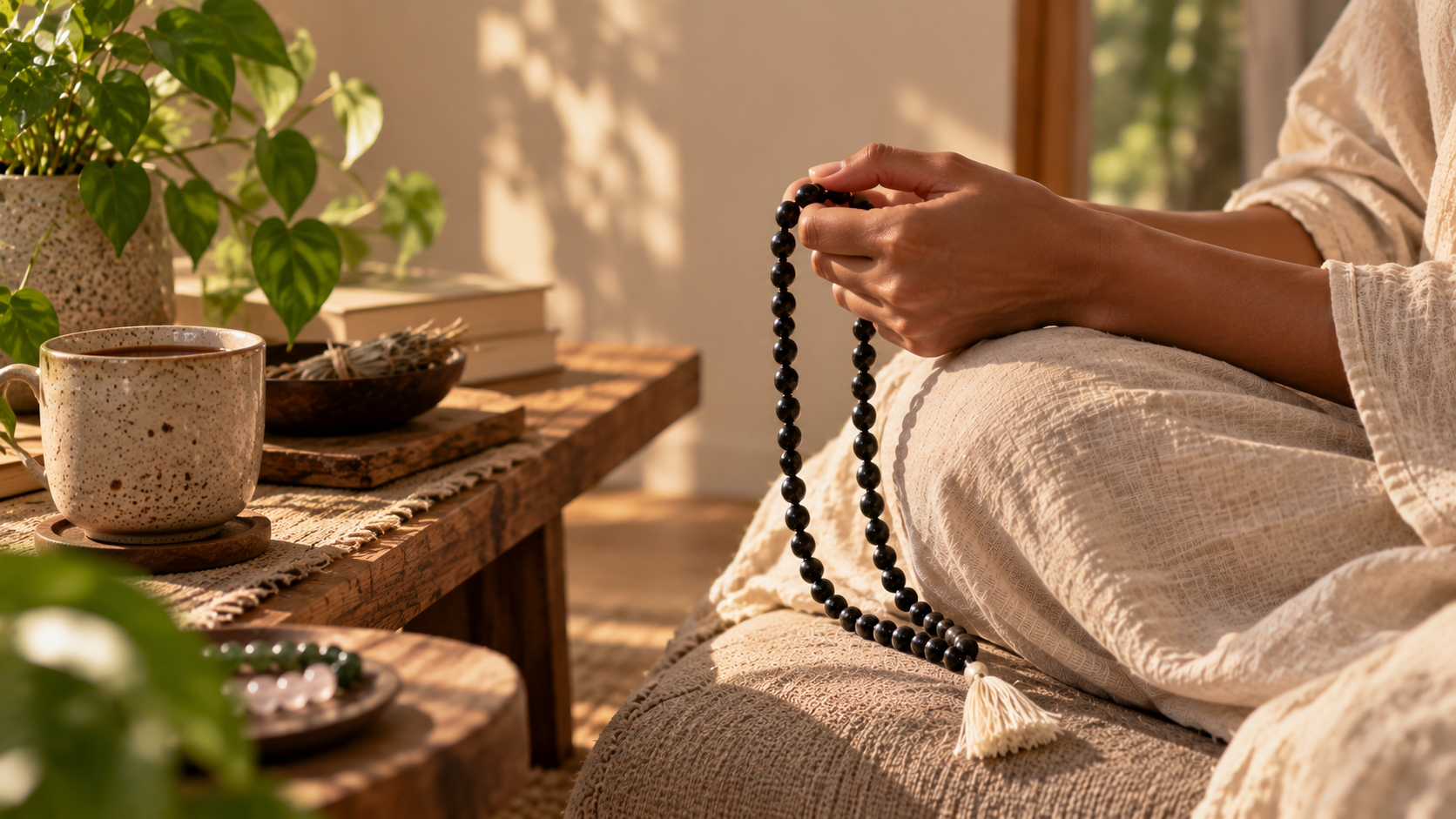
Every bead on a japmala can act as a small checkpoint. The thumb moves from one to the next, and in that small physical motion there may be a brief moment of attention. This is where the practice may actually live, not in the total count but in each individual return to the present bead, the present breath, the present word.
Minds tend to wander. This is not a flaw to be corrected so much as something that simply happens, especially during quiet moments when there is little external stimulation. A japmala may not stop this wandering. What it may do is offer a physical cue, something the fingers can feel, that gently signals when it is time to come back.
In this sense, counting without counting might be a more accurate description of the practice than counting itself. The number becomes almost incidental. What matters may be the repeated act of noticing that attention has drifted and choosing, bead by bead, to return.
Why the Hands May Matter as Much as the Mind
Meditation and mantra practices are often discussed purely in terms of mental focus, as though the mind alone does all the work. But the hands may play a quiet role that is easy to overlook. Moving a bead between the fingers gives the body something to do, which may reduce the restlessness that can come from sitting still with nothing physical to anchor attention.
For people who find seated stillness difficult, the tactile motion of a japmala may offer a bridge between complete stillness and the fidgeting the body naturally wants to do. Rather than suppressing the urge to move, the practice channels it into something small, repetitive and purposeful.
The Number 108 as a Container, Not a Goal
Much has been written about why a japmala traditionally holds one hundred and eight beads. Whatever the origin, the number may function less as a target to rush toward and more as a container that holds the practice in place. Knowing there is a beginning and an end may make it easier to stay present, since the mind does not need to wonder how much longer the sitting will last.
For those newer to the practice, using a shorter strand, such as twenty seven beads, may make the experience feel more approachable. The idea is not to prove endurance. It may simply be to build a habit of returning attention, again and again, in a way that feels sustainable rather than demanding.
What Happens Between the Beads
If asked to describe a japmala practice, many people might focus on the mantra or the breath being counted. But the space between one bead and the next may be just as significant. This is the moment where the mind either stays with the practice or slips away toward a memory, a worry or a plan for later. Noticing that slip, without frustration, and simply returning to the next bead may be the entire point of the exercise.
Over time, this repeated noticing may start to feel familiar in daily life as well. Some people report that the pattern learned on the mala, drifting and returning, drifting and returning, begins to show up outside the practice too. A wandering thought during a conversation or a task might be noticed and gently redirected in much the same way a bead is felt beneath the thumb.
A Practice That Does Not Require Belief
One aspect that may make japmala practice approachable is that it does not require adopting any particular belief system. A person can use a mala with a spoken mantra, a silent word, a simple breath count or even no words at all, simply moving through the beads while paying attention to the sensation of touch. The structure may be useful regardless of what, if anything, it is paired with spiritually.
This flexibility might be part of why the practice has traveled so widely across different traditions and continues to find new practitioners who are drawn more to the physical and mental steadiness it offers than to any particular doctrine behind it.
Making Room for the Practice
A japmala does not require a special room or a long stretch of free time. A few minutes with a shorter strand, perhaps while cacao is still warm in the cup or before starting a work task, may be enough to notice its effect. Some people like to keep their mala somewhere visible, such as near a desk or a bedside table, so it can be reached for without much planning.
There is no requirement to complete a full round every time it is picked up. Even a handful of beads, moved slowly and with attention, may offer a small reset within a busy day.
Returning, Again and Again
Perhaps the most honest way to describe what a japmala teaches is simply this. Attention will wander. That may be expected and even natural. The practice is not about preventing this from happening. It may be about building a gentle, reliable way of noticing when it does and choosing to come back, bead by bead, breath by breath, for as long as the strand allows.