Natural crystals can display an extraordinary range of colours, textures, and internal characteristics. Some may be remarkably clear, while others contain visible inclusions, cloudy areas, or unusual patterns. These characteristics are sometimes described as imperfections, particularly when gemstones are evaluated according to conventional jewellery standards. But does every natural variation need to be considered a flaw? Looking more closely at the characteristics of crystals might reveal why some of their most interesting features are the ones that make them different.
Why Don’t All Crystals Look the Same?
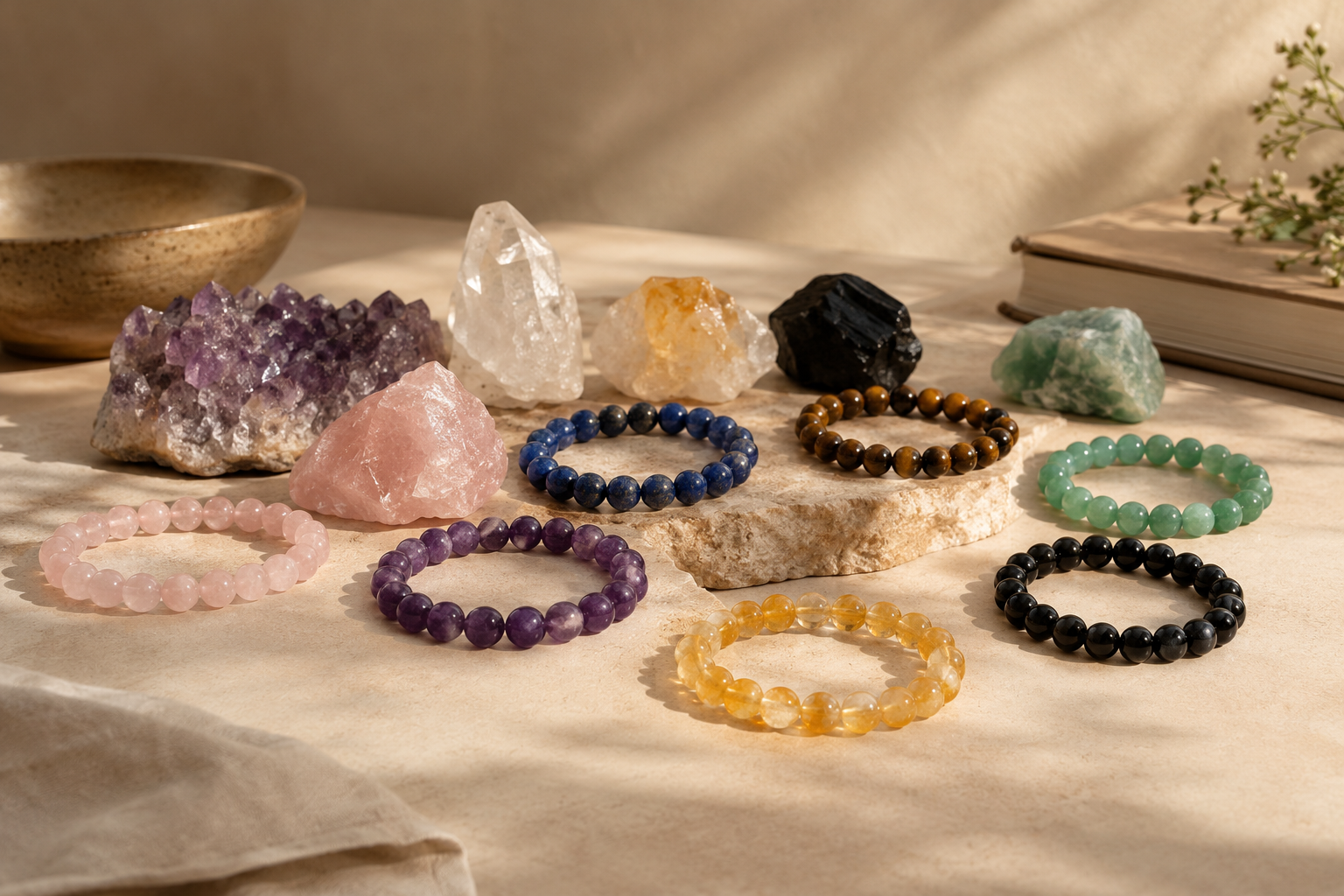
If you have ever examined a collection of Rose Quartz bracelets, you may have noticed that some beads are pale pink while others have a deeper, more saturated appearance. Some might be relatively translucent, while others look cloudy or opaque. These differences can arise from variations in mineral composition, inclusions, geological conditions, and the way the stones have been processed.
Even crystals belonging to the same mineral variety may develop under different environmental conditions. This can produce considerable diversity in their appearance. For example, Amethyst may display uneven purple colouring, with some areas appearing darker than others. Clear Quartz can contain internal fractures, mineral inclusions, or cloudy regions. Tiger’s Eye is known for its distinctive optical effect, which may appear differently depending on the orientation and arrangement of its internal fibres.
These variations can make individual stones visually distinctive. However, the appearance of a crystal can also be influenced by cutting, polishing, and certain treatments. Not every variation is necessarily evidence of an untreated natural origin.
The Little Details Hidden Inside Crystals
Have you ever held a crystal up to the light and noticed tiny patterns or unusual formations inside it? Some stones contain inclusions, which are materials or features enclosed within a mineral as it forms. Depending on the crystal, these may include other minerals, fluid-filled cavities, or internal structures.
Inclusions can sometimes provide useful information about the geological conditions under which a mineral developed. Gemologists may study these characteristics to help identify gemstones or investigate their origins and treatments. However, interpreting inclusions accurately can require specialised equipment and expertise.
A tiny mark visible inside a crystal bracelet may not tell us very much on its own. Still, observing these features can be fascinating. A stone that appears relatively ordinary from a distance might reveal intricate internal details when examined more closely. For someone who enjoys natural materials, these variations may be part of what makes collecting crystals interesting.
Why Perfectly Matching Beads Can Be Difficult to Find
Crystal bracelets are often made using beads that have been selected to create a consistent appearance. A bracelet containing beads of similar colour, size, and transparency may require careful sorting. Depending on the mineral, obtaining a particularly uniform collection of natural beads can be challenging. This is especially true when a stone naturally displays considerable colour variation.
Manufacturers may select beads from larger quantities of material to achieve a particular appearance. Other bracelets might intentionally include a wider range of natural shades and patterns. Both approaches can produce attractive jewellery.
A consistently coloured bracelet may appeal to someone who enjoys a polished, coordinated appearance. Another person might prefer visible variations that make each bead look slightly different. The choice can depend entirely on individual taste.
It is also worth remembering that uniformity alone does not establish quality or authenticity. Some natural gemstones can have consistent colouring, while dyed or synthetic materials may also display convincing variations.
Does an Imperfect Crystal Mean It Is Low Quality?
The word imperfection can be misleading when discussing natural stones. In conventional gemstone grading, characteristics such as clarity, colour, cut, and visible inclusions may influence how a stone is evaluated. However, the importance of these characteristics can vary depending on the mineral and its intended use.
A transparent gemstone used in fine jewellery may be assessed differently from an opaque decorative stone or a crystal bracelet. Some inclusions may reduce the commercial value of a particular gemstone, while others can create distinctive visual effects that collectors appreciate.
Natural variation does not automatically indicate poor quality. At the same time, not every crack or irregularity should be dismissed as an attractive natural feature. Significant fractures, poorly finished surfaces, or damaged drill holes may affect the durability of crystal jewellery.
When choosing a bracelet, it can be useful to consider both its appearance and its practical construction. Smoothly finished beads, secure stringing, and appropriate care may be important regardless of whether the stones have uniform colouring.
The Difference Between Natural and Artificial Imperfections
As interest in crystal jewellery has grown, so has the availability of treated, dyed, synthetic, and imitation stones. Some products may be altered to achieve colours or patterns that are difficult to find naturally. Others might be manufactured to resemble particular gemstones.
These materials are not necessarily unsuitable for jewellery, but accurate descriptions can help customers make informed decisions. A dyed stone should ideally be identified as dyed rather than presented as an untreated natural gemstone. Similarly, synthetic materials should not be marketed as naturally mined crystals.
However, distinguishing between these categories based on appearance alone can be difficult. A stone with uneven colouring is not automatically natural, and a perfectly clear crystal is not automatically artificial.
If authenticity is important to you, purchasing from a supplier who provides accurate material information may be more useful than relying on visual assumptions. For particularly valuable gemstones, independent gemological testing may offer additional information.
Why We Might Prefer Objects That Look Different
Our attraction to unusual patterns and natural variations is not limited to crystals. Some people enjoy handmade ceramics with slightly uneven surfaces, wooden furniture with visible grain patterns, or fabrics that contain subtle variations in texture. These characteristics can contribute to an object’s individual appearance.
Crystal jewellery may offer a similar experience. A Rose Quartz bracelet with beads in slightly different shades of pink might appeal to someone who enjoys softer, less uniform designs. Another person may prefer the dramatic patterns found in certain varieties of agate.
Our preferences can also change over time. You might initially choose crystals with consistent colouring but gradually develop an appreciation for more noticeable natural variations. Alternatively, you may continue to prefer a polished and coordinated appearance.
Neither preference necessarily indicates a deeper emotional or spiritual connection. Sometimes, we simply enjoy different forms of beauty.
Can an Imperfect Crystal Become Your Favourite?
Imagine receiving a crystal bracelet with one bead that looks slightly different from the others. Perhaps it has a darker inclusion, an unusual pattern, or a particularly interesting colour. You might initially notice the difference because it interrupts the bracelet’s otherwise consistent appearance.
Over time, however, that particular bead could become your favourite. It may be the one you notice first when putting on the bracelet or the detail that helps you recognise it among other pieces.
This kind of preference can develop with many personal possessions. We may become attached to the distinctive characteristics of an old piece of furniture, a handmade mug, or a favourite accessory. The features that make an object recognisable can sometimes become part of its appeal.
Of course, this does not mean that every damaged or poorly made product should be celebrated as unique. There is a difference between appreciating natural variation and accepting avoidable manufacturing defects. The interesting part is discovering which characteristics genuinely appeal to you.
Appreciating Crystals Beyond Conventional Perfection
The next time you explore a collection of crystal bracelets, you might enjoy looking beyond the most consistently coloured stones. Notice the subtle variations in Rose Quartz, the patterns in Tiger’s Eye, or the internal details that may be visible in Clear Quartz.
You may discover that some of the stones you find most interesting are not necessarily the ones that appear flawless. Their appeal might come from their colours, patterns, geological characteristics, or simply the way they look when worn.
There is no requirement to prefer imperfect crystals over perfectly polished ones. Both can be appreciated for different reasons. But recognising the diversity of natural stones may make choosing crystal jewellery a more interesting experience.
Sometimes, the smallest detail might be the very thing that makes a particular piece stand out to you.
Explore our collection of crystal bracelets and discover the unique colours and natural characteristics of different stones by clicking the image below.