Introduction: The City and the Sacred
There is a particular kind of exhaustion that belongs to urban life. It is not just physical tiredness — it is the cumulative weight of constant stimulation, noise, decision-making, social performance, and the relentless forward momentum that cities seem to generate by their very nature. It is the exhaustion of never quite arriving anywhere, because the next thing is always already beginning.
Into this landscape, the practice of cacao ceremony has arrived — not as an imported curiosity, but as a response to a genuine hunger. Urban dwellers across the world are increasingly finding their way to ceremonial cacao, drawn by something they often struggle to articulate: a need for pause, for depth, for an experience that cuts through the noise and returns them to themselves.
This is an exploration of what it means to integrate the practice of cacao into an urban life — and why, far from being an exotic transplant from another world, it may be one of the most practically relevant wellness practices available to the modern city dweller.
Why Urban Life Creates a Particular Need for Sacred Pause
To understand why cacao ceremony resonates so powerfully in urban contexts, it helps to understand what urban environments do to the nervous system over time.
Cities are, by design, high-stimulus environments. The constant presence of noise, crowds, artificial light, screens, and social information keeps the nervous system in a state of sustained activation. This is not inherently pathological — human beings are remarkably adaptive — but sustained sympathetic activation has a cumulative cost. Chronic stress, difficulty with presence, emotional numbness, and a persistent sense of disconnection from one’s own experience are among the most common symptoms of nervous system dysregulation in urban populations.
Sacred pause — intentional interruption of the ordinary momentum of life — is not a luxury in this context. It is a physiological necessity. The nervous system requires periods of genuine rest and receptivity to regulate, process, and integrate experience. Without them, the accumulation of unprocessed stress and disconnection gradually erodes resilience, creativity, emotional range, and the capacity for genuine connection with others.
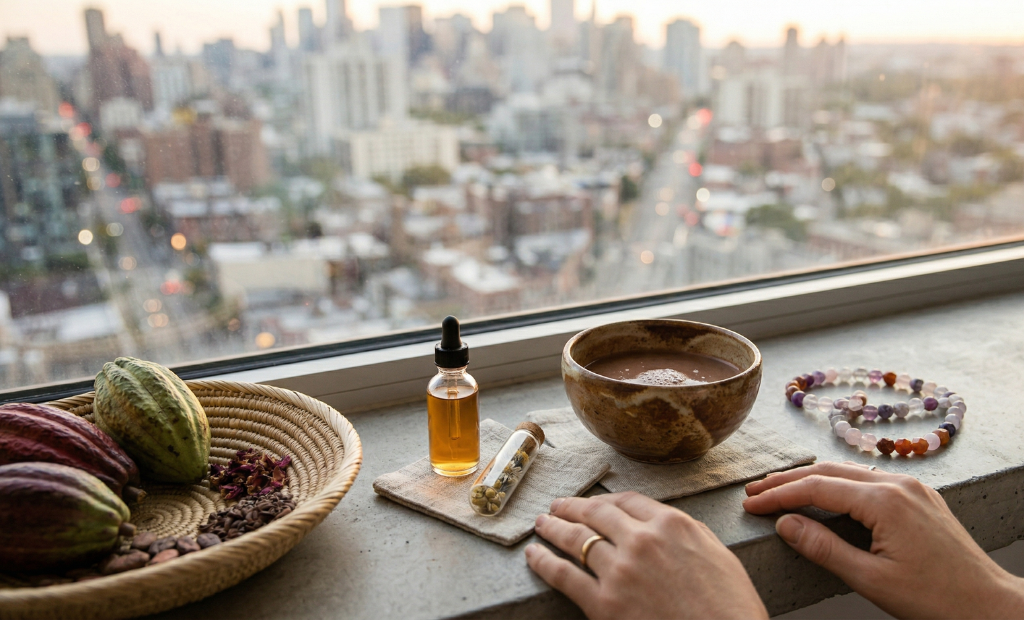
Cacao ceremony, even in its most modest urban form — a carefully prepared cup, a quiet morning, a few minutes of intentional presence — provides exactly this. It is a practice of interruption: not avoidance, but honest encounter with oneself before the day claims every available moment of attention.
The History of Cacao as a Practice for Everyday Life
One of the most important and often overlooked truths about ceremonial cacao is that it was never exclusively a high ceremony practice. While cacao was certainly used in major ritual contexts across Mesoamerican cultures — in Mayan cosmological ceremonies, in Aztec royal and religious rites — evidence from archaeological and anthropological research also shows that cacao was a regular, daily practice for many people, integrated into the rhythms of ordinary life.
The Mayan word for cacao, kakaw, appears in contexts ranging from elaborate cosmological texts to mundane household accounts. Cacao was consumed at the beginning of the day, shared in community gatherings, offered to guests, and used to mark small transitions as readily as major ones. The ceremonial and the everyday were not separate domains — they were woven together.
This historical context matters because it liberates contemporary cacao practice from the idea that it requires elaborate preparation, special settings, or formal ceremony to be legitimate. The practice of bringing intention and care to the preparation and consumption of cacao — of treating it as something more than a beverage — is itself a form of ceremony, however simple.
Creating a Cacao Practice for Urban Life: The Foundations
Building a sustainable cacao practice in an urban context doesn’t require transforming your apartment into a jungle sanctuary or blocking entire days for ceremony. It requires three things: quality cacao, a genuine intention, and the willingness to create a temporary container of presence.
Quality cacao matters more than many people realize. The ceremonial cacao available through reputable suppliers is significantly different in its composition — and its effect — from commercial chocolate or even standard cooking cacao. Genuine ceremonial cacao is minimally processed, made from whole cacao paste or butter, and retains the full spectrum of active compounds including theobromine, magnesium, anandamide, and phenylethylamine. The physiological experience of drinking it — the gentle warmth, the subtle heart opening, the quality of presence it supports — is genuinely distinct from drinking a cup of hot chocolate.
Sourcing your cacao from suppliers who work directly with indigenous farming communities also matters — not just ethically, though ethics are important, but because the quality and energetic integrity of traditionally produced cacao tends to be significantly higher than commercially sourced alternatives.
Once you have quality cacao, the practice is remarkably simple. Choose a time when you can give yourself at least 20-30 minutes of undivided presence. Morning tends to work well for urban practitioners — before the day’s demands have fully claimed your attention. Prepare your cacao with care: hot water, a natural sweetener if desired, spices you enjoy, stirred or blended with intention. As you prepare it, begin to bring your awareness inward.
The Urban Ceremony: What to Do With Your 30 Minutes
The urban cacao practice doesn’t need a script. But having some sense of how to use the space you’ve created can be helpful, particularly when you’re beginning.
Begin with arrival. Before you drink, take a few minutes to simply arrive — in your body, in the space, in the present moment. Close your eyes. Take three slow, deliberate breaths. Feel your feet on the floor. Let the sensory reality of your surroundings come into focus: the warmth of the cup, the smell of the cacao, the ambient sounds of the city outside. The act of intentional arrival is itself a ceremony.
Hold an intention. As you begin to drink, bring to mind something you’d like to carry through the space: a question you’re sitting with, an area of your life asking for attention, a quality you’d like to cultivate, or simply the intention to be present with yourself. This transforms a pleasant morning ritual into a purposeful practice.
Allow, don’t direct. The middle of your cacao practice — perhaps 15-20 minutes of quiet sitting after you’ve finished drinking — is for receiving rather than doing. Resist the urge to fill the space with productive thinking or planning. Allow what arises to arise: sensation, feeling, imagery, insight, or nothing at all. The emptiness is as valid as the fullness.
Close with gratitude. Before you move back into the day, take a moment to close the space with intention — a simple acknowledgment of the time you gave yourself, a breath of gratitude for the cacao and what it offered, a gentle transition back toward the ordinary. This simple act of closing creates a clear distinction between ceremony time and regular time, and trains the psyche to treat the practice as genuinely sacred.
Cacao Ceremony in Community: Finding Your Urban Tribe
While the personal practice of cacao is deeply valuable, the communal dimension of ceremony adds something that individual practice cannot fully replicate. Cacao has historically been a social medicine as much as a personal one — a substance that facilitates authentic connection between people, lowering social defenses and creating conditions for genuine meeting.
Urban cacao circles have proliferated significantly over the past decade, and most major cities now have active communities gathering regularly for shared ceremony. These range from small, intimate gatherings hosted in private homes to larger community ceremonies in yoga studios, wellness centers, and event spaces. Finding one that resonates — with the quality of facilitation, the values of the community, and the intention of the practice — is worth the effort of research.
Attending a well-held cacao circle as an urban dweller can be a genuinely transformative experience, not because anything extraordinary is guaranteed to happen, but because the experience of genuine presence in community — of being with other people without performance or agenda — is increasingly rare and increasingly needed. Many participants describe the experience of a cacao circle as the first time in weeks or months they felt truly themselves in a room full of people.
Adapting the Practice: Realistic Guidance for Busy People
For many urban dwellers, the greatest obstacle to establishing a cacao practice is not interest or intention — it is time. A few practical adaptations can make the practice genuinely sustainable even in demanding schedules.
On full-ceremony days (once a week or less frequently), give yourself the full 30-60 minute container described above. Treat it as a genuine appointment with yourself — something in your calendar that you protect with the same seriousness you’d give a work meeting.
On ordinary days, a shorter version still carries significant value. Even 10 minutes of intentional presence with a cup of cacao — away from screens, with a simple breath and arrival practice — maintains the thread of the practice and provides genuine nervous system support. The dose of theobromine and magnesium in even a small amount of quality ceremonial cacao supports heart-brain coherence and calm alertness throughout the day.
When time is genuinely impossible, carry the spirit of the practice into other moments. The cacao ceremony teaches a quality of attention — slow, receptive, present — that can be brought to any moment: a meal, a walk, a conversation, a moment of stillness on public transit. The practice is ultimately not about the cacao. It is about the orientation toward experience that the cacao invites.
Conclusion: Reclaiming Depth in a Fast-Paced World
Urban life is not going to slow down on its own. The structures, incentives, and rhythms of city living are oriented toward speed, productivity, and perpetual stimulation — and they will remain so regardless of what any individual chooses to do. This is simply the nature of the environment.
What changes when you bring a cacao practice into your urban life is not the city. It is your relationship to the city — and more importantly, to yourself within it. A regular practice of sacred pause, however modest, gradually changes the baseline. It gives the nervous system regular opportunity to regulate and integrate. It builds a relationship with your own interior life. It restores a felt sense of depth to days that can otherwise feel relentlessly shallow.
The ancient traditions that developed cacao ceremony understood something that modern life has largely forgotten: that without regular return to the interior, without consistent practice of pausing to listen to oneself, life loses its meaning and eventually its direction. The cup of cacao is a doorway — small enough to fit into a city apartment, deep enough to touch something that no city, however magnificent, can provide.
You don’t need to leave your urban life to find the sacred. You need only pause long enough to remember that it was always here.