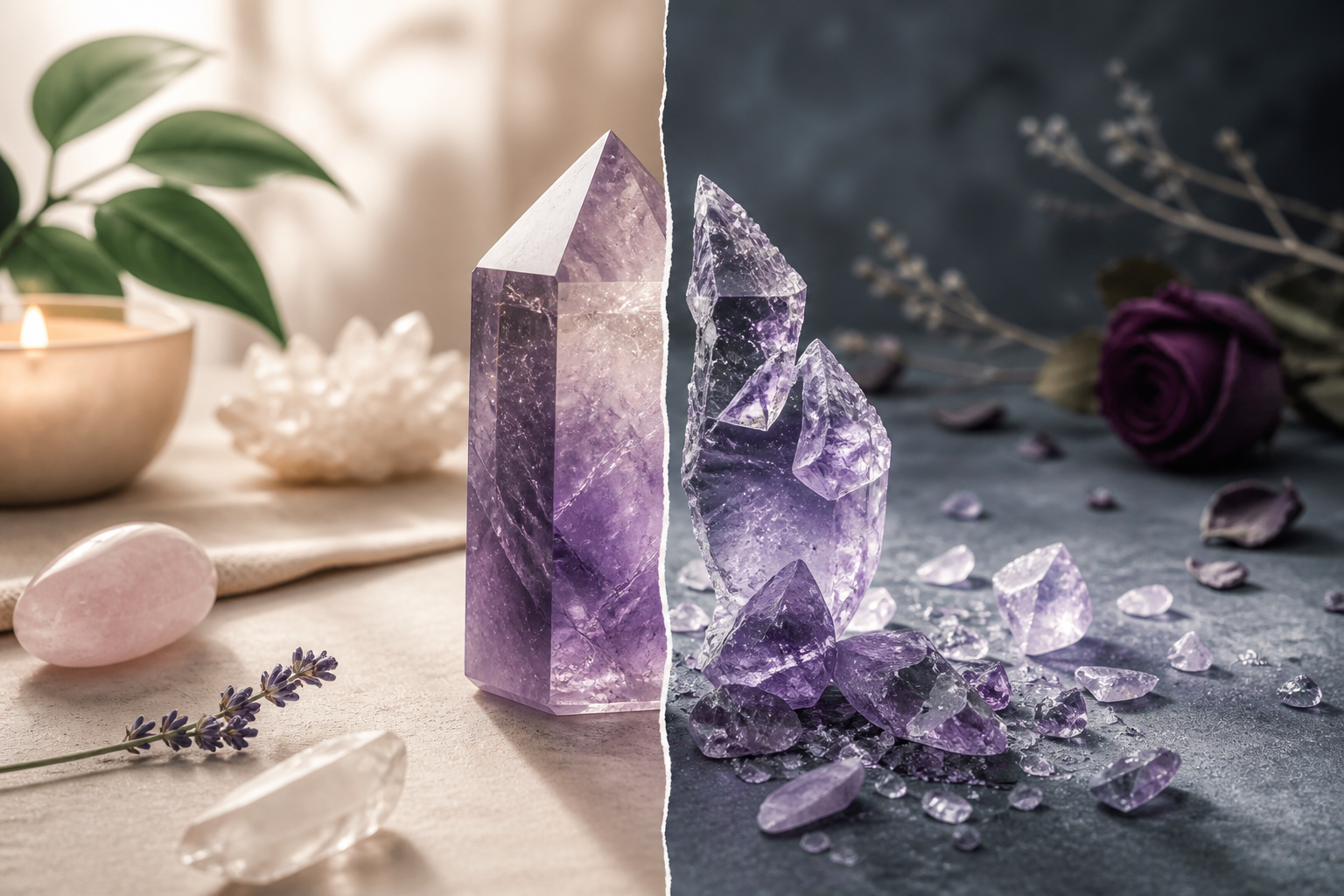
It happens to almost every crystal lover at some point — you reach for your favorite piece, or it tumbles from a shelf, and you hear that unmistakable crack or shatter. A broken crystal can feel surprisingly significant, and many people find themselves wondering what it means, what they should do, and whether the crystal is now ‘ruined.’ This blog explores the phenomenon of crystal breakage from both a practical standpoint and a symbolic one, offering multiple perspectives so you can decide what resonates most with your own relationship to these remarkable natural objects.
First, the Practical Reality
Crystals are minerals, and like all physical materials, they have structural properties that make them susceptible to breakage under certain conditions. Most crystals have specific cleavage planes — directions along which they are more likely to break when struck or dropped, based on the arrangement of atoms in their internal structure. This is why some crystals like selenite or calcite can shatter quite easily, while others like quartz or jasper may be more durable. Hardness, as measured on the Mohs scale, is a related but different property — a crystal can be hard but still brittle.
Temperature changes, accidental drops, improper storage, or even vibrations over time can all contribute to breakage. Some crystals are naturally prone to developing fine internal fractures called inclusions, which may eventually cause them to split along those lines. Understanding this purely material dimension can be grounding — sometimes a crystal breaks simply because it was dropped, and no deeper meaning may be required.
Once broken, a crystal’s mineral structure remains intact in each piece. From a geological standpoint, the crystal is not destroyed — it has simply become multiple smaller crystals. Many people choose to keep, work with, or repurpose broken pieces rather than discarding them, and there can be genuine beauty and usefulness in a crystal’s fragments.
The Symbolic and Spiritual Perspectives
For those who work with crystals within a spiritual or metaphysical framework, a broken crystal can carry a range of symbolic interpretations. It is worth noting that these perspectives vary widely across different traditions, practitioners, and belief systems — and none of them is universally agreed upon. What follows is a survey of common interpretations, offered not as definitive truth but as one potential layer of meaning.
One of the most widely shared interpretations in crystal healing communities is that a crystal breaks when it has ‘completed its work’ or absorbed as much energy as it can hold. In this view, the breaking is seen as a sign that the crystal has served its purpose and is releasing what it has taken on. This interpretation may be comforting for those who feel distressed about a breakage, reframing it as a completion rather than a loss.
Another perspective holds that a crystal breaks in order to reach more people or more areas of your life — that its energy is now available in multiple forms. Someone who finds this meaningful might place the broken pieces in different rooms, share them with friends, or use each piece for a different intention. This reframing transforms a sense of loss into a sense of expansion.
Some practitioners interpret a crystal’s breaking as a signal from their intuition or inner guidance that a particular chapter or cycle is ending, that something they were holding on to is being released, or that a shift in energy is occurring in their life. In this framework, the breakage might be seen as synchronistic — meaningful in the way that an unexpected event can prompt self-reflection and awareness.
When It Might Be Energetically Significant
Those who work closely with crystals often report that certain breakages feel more charged or significant than others — particularly when a crystal breaks during an emotionally intense period, during a healing session, or after a period of heavy use. Whether this is due to actual energetic phenomena or the human mind’s tendency to find meaning in coincidence (a well-documented cognitive phenomenon known as apophenia), it may still be worth paying attention to the circumstances of a breakage as a prompt for reflection.
If a crystal that you have been working with for a long time — perhaps one associated with a particular intention, relationship, or phase of life — suddenly breaks, it might be an invitation to pause and consider what that crystal represented for you. Not because the crystal necessarily ‘knows’ something, but because the process of reflecting on it may surface insights that are already present within you.
What to Do With a Broken Crystal
Once a crystal has broken, you have several options depending on your practical needs and personal orientation. If the break is clean and the pieces are still large enough to work with comfortably, you might simply continue using each piece as a separate crystal. Many people find that smaller tumbled pieces or fragments are ideal for placing around the home, carrying in a pocket, or adding to a grid or altar.
If the edges are sharp, you may want to sand them gently or wrap them in cloth for safety. Selenite, fluorite, and other softer crystals can produce sharp edges that should be handled with care. Some crystal enthusiasts use broken pieces in plant pots, as garden decorations, or incorporated into artwork and jewelry — finding new aesthetic and functional lives for their once-whole crystals.
From a cleansing perspective, if you work within a tradition that practices energetic cleansing of crystals, it may feel right to cleanse the broken pieces before continuing to work with them — whether through sunlight, moonlight, sound, smoke, or intention. This can feel like a reset or a ceremonial acknowledgment of the transition the crystal has undergone.
If a crystal breaks into very small pieces or into dust, it may be safest to return the material to the earth — burying it in the garden or a plant pot — rather than keeping sharp fragments. This can also feel symbolically meaningful, as a return to origin.
What It Might Mean for Your Practice
Beyond the immediate question of what to do with the physical pieces, a broken crystal might be an invitation to examine your relationship with your crystals and your practice more broadly. Do you feel attached to crystals as objects? Are there crystals you are particularly afraid of losing or breaking? Exploring these feelings — not with judgment, but with curiosity — can be a genuinely enriching dimension of crystal practice.
Impermanence is one of the fundamental teachings of most wisdom traditions, and even the most beloved crystal is not immune to it. Learning to hold crystals — and the intentions, memories, and feelings they represent — with a gentle, open grip might be one of the deeper gifts that a breakage can offer.
Ultimately, what a broken crystal means is something only you can determine, informed by your own beliefs, relationship with the stone, and the circumstances of its breaking. Both perspectives — the practical and the symbolic — can coexist, and you do not necessarily need to choose one to the exclusion of the other. Crystals, like life, may hold more meaning when we allow them to be layered and complex.