The word ceremony tends to conjure specific images. A wedding procession, a religious rite performed by a robed official, a graduation with caps thrown into the air. These associations are not wrong, but they may be incomplete. They suggest that ceremony requires institutional backing, a recognized authority figure, or a fixed set of religious beliefs in order to count as legitimate. For those without a formal religious affiliation, or those who feel disconnected from the traditions they were raised in, this narrow framing can make ceremony feel inaccessible, as though it belongs to other people and other systems rather than something available for personal use.
Ceremony and religion have long overlapped, but they are not the same thing. Religion typically involves a shared belief system, often including ideas about the divine, morality, and the nature of existence, along with a community of practitioners who hold these beliefs in common. Ceremony, by contrast, might be better understood as a structured, intentional set of actions performed to mark, honor, or transform something significant. Religion frequently makes use of ceremony, but ceremony does not require religion in order to function.
Consider a person who lights a candle each year on the anniversary of a loss, sits quietly for several minutes, and then blows it out. There is no deity invoked, no institution overseeing the act, no shared community witnessing it. And yet the structure, the intention, and the marking of significance all remain present. Many would recognize this as a ceremony, even in the complete absence of any religious framework.
If ceremony does not require religious belief, what does it actually require? A few recurring elements tend to appear across the wide range of practices that people describe as ceremonial, whether religious or entirely secular.
Intention seems to be one of the more essential ingredients. A ceremony tends to be performed with a specific purpose in mind, whether that purpose is marking a transition, honoring a person or event, seeking clarity, or releasing something no longer needed. Without this underlying intention, an action risks becoming simply a habit or routine rather than something carrying ceremonial weight.
Structure also appears frequently, though the degree of structure can vary considerably. Some ceremonies follow an elaborate, multi-step sequence developed over generations. Others might involve nothing more than a single repeated gesture, such as lighting a candle or reciting a short phrase. What seems to matter is that the structure, however simple, is deliberate rather than incidental, chosen specifically because it supports the intention behind the act.
A sense of separation from ordinary time or activity often plays a role as well. Anthropologists studying ritual across cultures have long noted that ceremonies tend to involve some kind of threshold, a marker that distinguishes the time and space of the ceremony from everyday life. This might be as simple as sitting in a particular spot, dimming the lights, or setting aside a phone before beginning. The threshold signals to the mind that something different is about to happen, separate from the usual flow of daily tasks.
In recent years, many people who feel disconnected from organized religion have begun creating their own ceremonies, drawing loosely from various traditions while adapting practices to fit their personal beliefs and circumstances. This might look like a solo new moon ritual involving journaling and quiet reflection, a small gathering of friends to mark a divorce or career change, or a private morning practice combining elements of breathwork, movement, and intention setting borrowed from several different traditions.
Some critics have raised concerns about this kind of eclectic, self-assembled ceremony, suggesting that it risks becoming shallow or disconnected from the deeper cultural and historical context that gave rise to specific ritual elements in the first place. This concern carries some validity, particularly when specific practices are lifted from marginalized or closed traditions without acknowledgment or understanding of their origins. At the same time, humans across history have consistently borrowed, adapted, and reshaped ritual practices to fit new circumstances, and the impulse to create personal ceremony, when approached thoughtfully and with respect for where various elements originate, seems to reflect a genuine and longstanding human need rather than a purely modern indulgence.
A person does not need to believe in any particular metaphysical framework in order to benefit from ceremony. Psychological research on ritual behavior has found that structured, repeated actions can help regulate emotion, reduce anxiety, and provide a sense of control during periods of uncertainty or transition, regardless of whether the person performing the ritual holds any specific belief about why it works. Some studies have specifically examined rituals performed after loss or during grief, finding that the act of engaging in a structured, symbolic behavior appears to offer measurable comfort even among participants who describe themselves as entirely secular.
This suggests that ceremony may function, at least in part, through mechanisms that have little to do with belief in the supernatural and much more to do with the psychological effects of structure, intention, and marked transition. A person does not need to believe a candle carries any mystical property in order to find comfort in the act of lighting one during a difficult moment. The ceremony offers a container for emotion and attention, and that container can hold meaning regardless of the specific belief system, or absence of one, that a person brings to it.
For those interested in creating their own ceremonial practices, a few starting questions might help clarify what such a practice could look like.
There is no requirement that a personal ceremony remain fixed once created. Many people find that their ceremonies evolve over time, shedding elements that no longer feel meaningful and incorporating new ones as circumstances change. This flexibility stands in some contrast to more institutionally bound religious ceremonies, which often maintain consistent form specifically because that consistency carries its own kind of value within a shared community. Personal ceremony, existing outside those structures, has more room to shift and adapt to an individual’s changing life.
Perhaps the most useful reframe is to think of ceremony not as a fixed category requiring specific credentials or beliefs but as an ongoing conversation between a person and the moments in their life that feel significant enough to mark. This conversation can borrow from established traditions, invent entirely new forms, or blend the two in whatever combination feels most honest to the person creating it. What ultimately makes something a ceremony may have less to do with its outward form and more to do with the intention, attention, and care brought to the act itself.
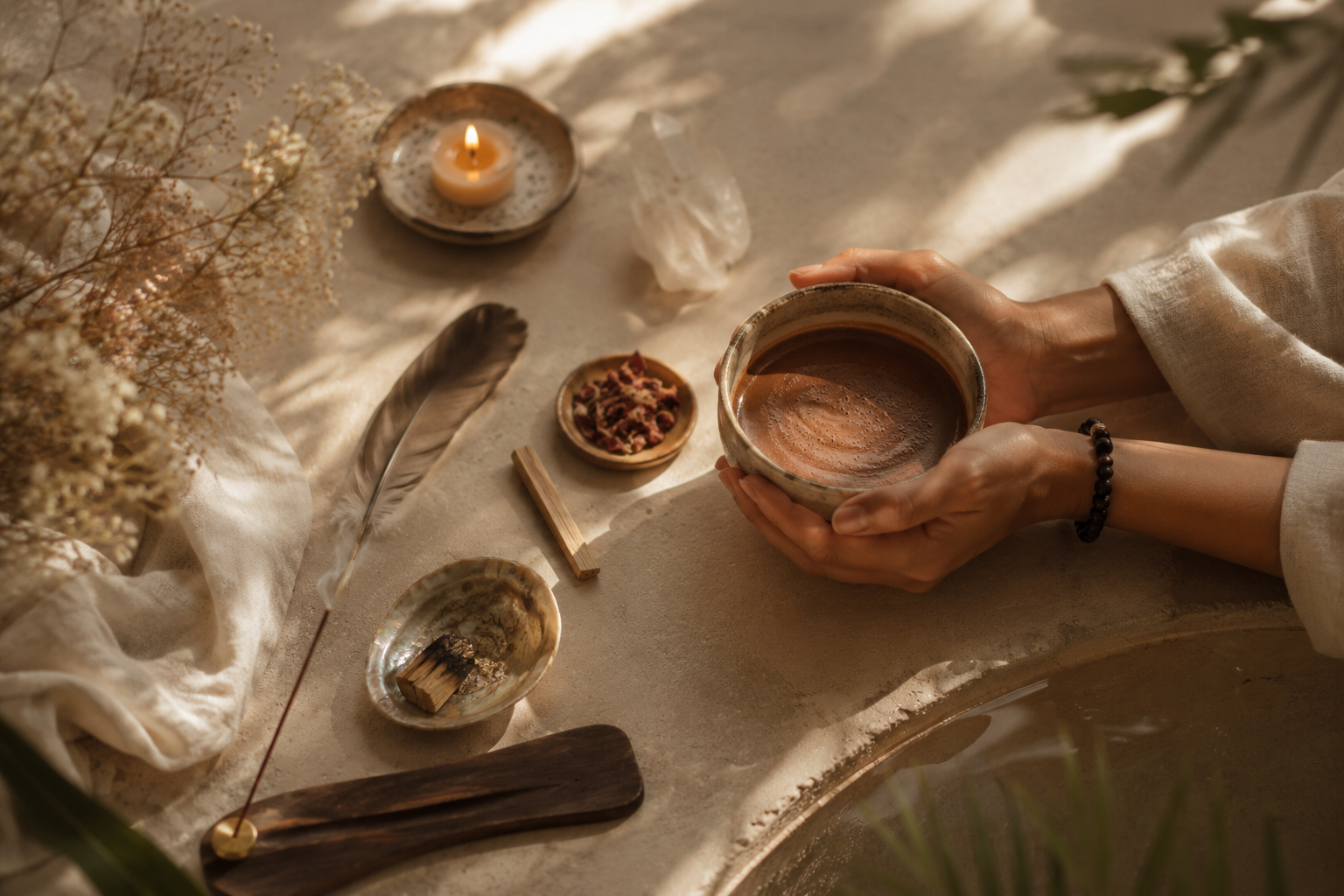
If you are ready to create a meaningful ritual of your own, explore our collection of ceremonial cacao, 108-bead japmalas, crystal bracelets, tealight holders, and other ritual tools designed to support intentional living, mindfulness, and personal ceremony.

Our offerings—ceremonial cacao, crystals, candles, and journals—are designed to support mindfulness, self-connection, and sacred daily rituals. Every product is ethically sourced, handcrafted with care, and infused with meaning to help you slow down, tune in, and create moments of presence.
© 2025 All rights reserved Conscious Collective