An incense holder might seem like a simple accessory, easily overlooked next to the incense itself. Yet the shape, material, and design of a holder can influence the experience of burning incense in ways that go beyond mere practicality. From the classic straight stick holder to elaborate boat-shaped ash catchers to backflow burners that send smoke cascading downward like a small waterfall, the design choices behind incense holders reflect both functional necessity and a set of aesthetic and even spiritual considerations that have developed over centuries.
At the most basic level, an incense holder exists to solve a fairly simple problem. Burning incense produces both heat and falling ash, and without something to catch these byproducts, using incense indoors would quickly become impractical or even dangerous. This basic function shapes much of incense holder design, regardless of the particular style or tradition involved.
Stick incense, the most widely available form in many parts of the world, typically requires a holder with a small hole or groove to keep the stick upright and stable while it burns. Because stick incense burns at an angle when held horizontally or continues burning steadily when held vertically, the holder needs to account for the direction of ash fall, usually by providing a small tray or channel beneath the stick to catch debris as it drops.
Cone incense presents a different set of practical requirements. Since the entire cone rests directly on a surface rather than being held upright by a stem, cone holders often take the form of a small dish or bowl, sometimes filled with sand or ash to help insulate the heat and prevent damage to whatever surface sits beneath the holder.
Coil incense, which can burn for many hours due to its extended spiral shape, typically requires a holder designed to suspend the coil above a surface, since the coil’s shape means ash and heat need to be managed across a wider area and for a longer duration than either sticks or cones.
In recent years, backflow incense cones have become particularly popular, largely because of the striking visual effect they produce. Unlike traditional incense, which sends smoke rising upward, backflow incense is formulated to be denser than air once burned, causing the smoke to flow downward instead. Holders designed for this type of incense typically feature an elevated platform with a hole beneath the cone, along with some kind of structure below, often shaped like a mountain, a bridge, or a natural landscape feature, over which the smoke can flow as it descends.
This particular style of holder illustrates something interesting about the relationship between form and feeling. While a simple flat dish could technically catch the ash and support a backflow cone, the elaborate landscape structures common to these holders exist specifically to enhance the visual spectacle of the downward-flowing smoke. The design choice here has moved well beyond pure practicality into the realm of creating a particular emotional or contemplative effect, turning the incense holder into something closer to a small piece of kinetic art.
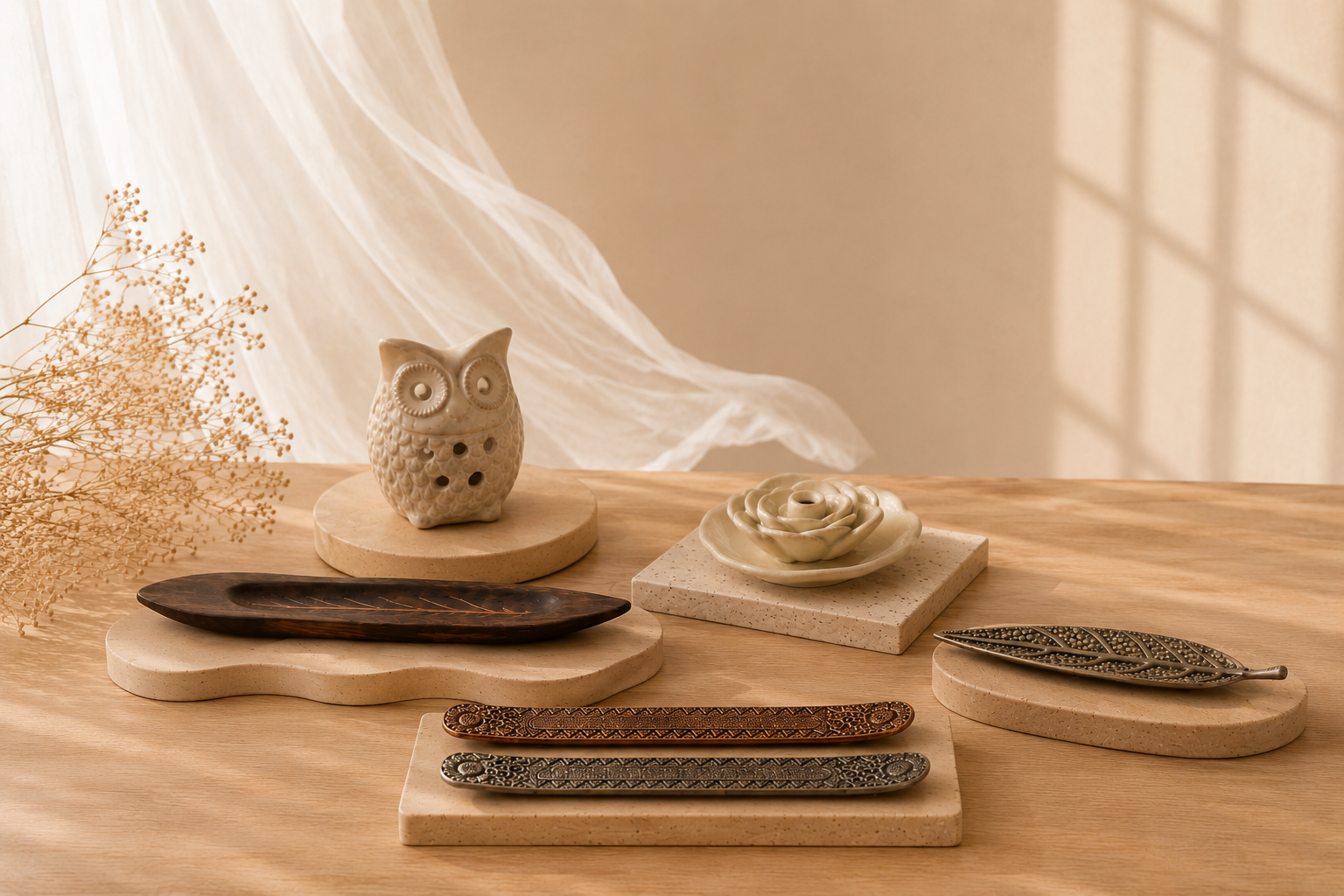
Beyond shape, the material of an incense holder carries its own set of practical and symbolic considerations. Ceramic incense holders remain among the most common choices, valued for their heat resistance, relative affordability, and the wide range of finishes and glazes available. Stone incense holders, whether carved from soapstone, marble, or other materials, tend to carry a particular sense of permanence and groundedness, often chosen by practitioners who want their ritual tools to feel weighty and enduring rather than delicate.
Wooden incense holders, while requiring more care to avoid heat damage, are sometimes favored for their natural warmth and the way they age and develop character over time with continued use. Metal incense holders, particularly brass or copper, appear frequently in more traditional or devotional contexts, sometimes chosen specifically because certain metals carry symbolic associations within particular spiritual traditions.
Beyond the purely functional distinctions required by different incense formats, the specific shape and design of a holder often reflects broader intentions about how the object will be used and experienced. A minimalist, unadorned holder made of plain stone or simple ceramic might suit a practice focused on stripping away distraction, allowing the incense and its scent to remain the clear focal point without competing visual elements. A more elaborate holder, carved with symbolic imagery or shaped to evoke natural landscapes, might suit a practice that values visual richness and layered meaning as part of the overall ritual experience.
Some practitioners choose holders shaped like specific symbols meaningful within their particular tradition, such as lotus flowers, mandalas, or figures associated with particular deities or spiritual figures. Others prefer entirely abstract or geometric shapes, finding that non-representational forms leave more room for personal interpretation and evolving meaning over time rather than fixing the object’s significance to a single symbolic reference.
The physical size of an incense holder also shapes how it functions within a broader ritual or altar space. A small, portable holder might suit a practice that moves between different rooms or travels alongside a person, offering flexibility at the cost of some stability or elaborate design. A larger, more substantial holder tends to anchor itself as a fixed point within a dedicated ritual space, becoming a permanent fixture around which other elements of practice are arranged.
Placement itself carries meaning for many practitioners. A holder positioned at eye level while seated might draw more conscious attention throughout a practice session, while one placed lower or slightly to the side might function more as ambient support, present in the background without demanding direct focus. Some traditions offer specific guidance about appropriate placement relative to other altar elements, windows, or directions, while more personal or eclectic practices often leave this entirely to individual preference and experimentation.
For those selecting an incense holder for their own practice, it may help to start by considering the specific type of incense most likely to be used regularly, since stick incense, cone incense, coil incense, and backflow incense each carry somewhat different practical requirements. From there, material and shape become largely a matter of personal resonance rather than fixed rule, though those following a specific spiritual tradition may want to research whether particular materials or shapes carry meaning within that tradition before making a selection.
It may also be worth considering how visually active a holder should be within the broader practice. Some practitioners find that an elaborate, visually engaging holder enhances their sense of ceremony and occasion, while others find that visual simplicity better supports the kind of quiet, undistracted attention they hope to cultivate during practice. Neither approach holds inherent superiority over the other, and many practitioners find that their preferences shift over time as their practice itself continues to evolve.
What begins as a simple functional necessity, namely catching ash and supporting a burning stick or cone safely, has clearly evolved across cultures and centuries into an object carrying considerable aesthetic and symbolic weight. The shape of an incense holder does more than solve a practical problem. It frames the entire sensory experience of burning incense, shaping how smoke moves, how attention is drawn, and how the overall moment feels to the person engaging in the practice.
If you are looking to create a mindful ritual space, explore our collection of incense holders, incense stick holders, and ritual tools. Whether you prefer minimalist ceramic designs, handcrafted wooden holders, or elegant brass finishes, you’ll find pieces designed to bring beauty, intention, and functionality to your daily rituals.

Our offerings—ceremonial cacao, crystals, candles, and journals—are designed to support mindfulness, self-connection, and sacred daily rituals. Every product is ethically sourced, handcrafted with care, and infused with meaning to help you slow down, tune in, and create moments of presence.
© 2025 All rights reserved Conscious Collective