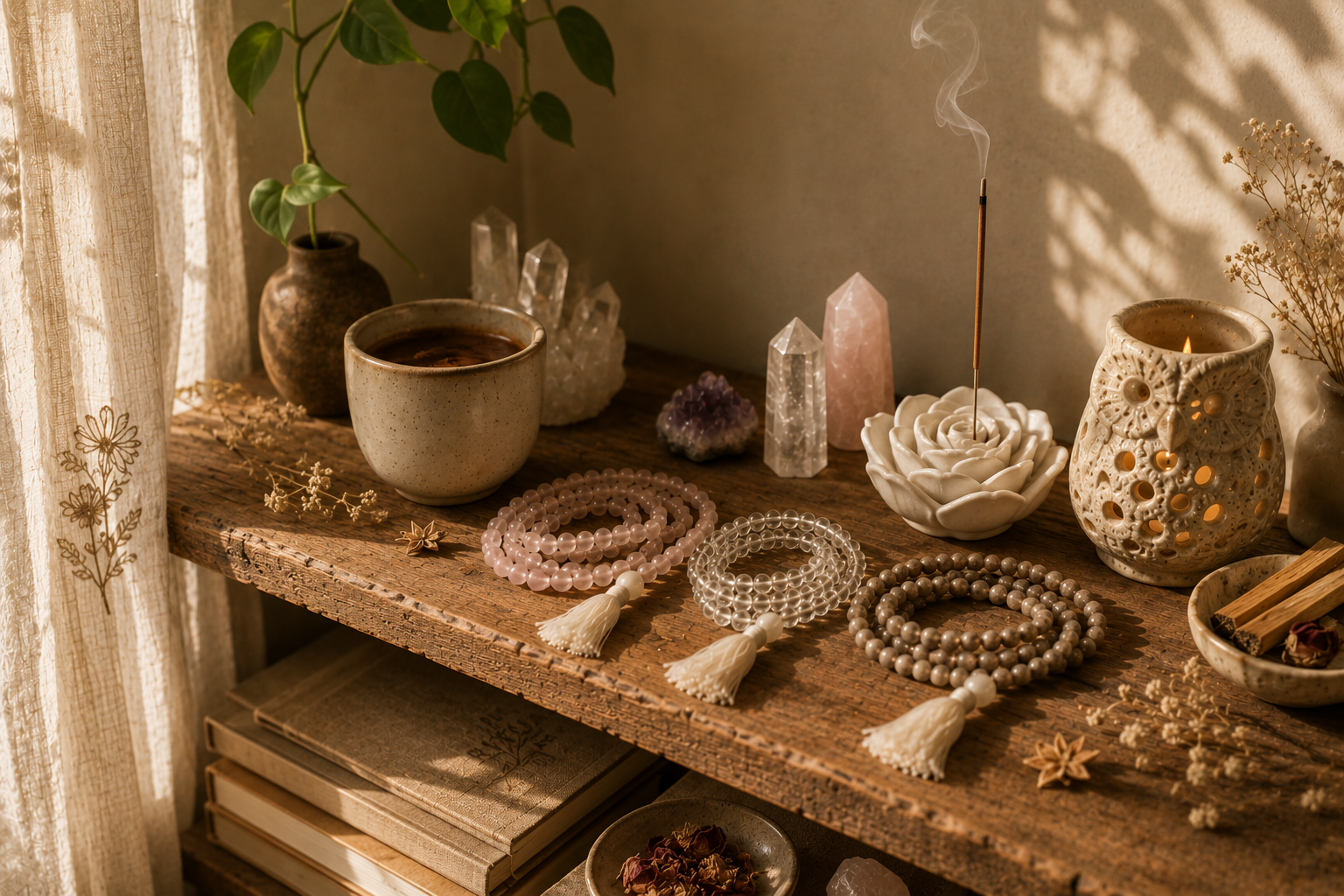
A ritual space does not need to be elaborate to feel meaningful. It does not require an entire room, expensive objects, or a carefully styled corner that looks perfect in photographs. Sometimes, a small surface beside your bed, a shelf in the living room, or even one quiet corner of a desk can become a place you naturally return to when you want to slow down.
What makes a ritual space meaningful is not necessarily what is placed inside it, but the relationship you develop with the objects that live there. A cup of cacao, a crystal bracelet, a Japmala, an incense holder, or the gentle light of a tealight can become familiar signals that tell the body and mind that it is time to pause.
The ritual shelf is therefore less about decoration and more about creating a physical environment that supports attention, intention and presence.
Why Having a Dedicated Ritual Space Can Matter
Modern life often asks us to move quickly between different roles and environments. We work at the same desk where we scroll through our phones, eat meals while answering messages, and sometimes carry unfinished thoughts from one part of the day into another.
A dedicated ritual space creates a small distinction between ordinary activity and intentional time.
The space itself does not possess to have any special power. Its value can come from repetition. When the same objects are repeatedly associated with moments of stillness, reflection or connection, simply seeing them can eventually become a familiar cue to slow down.
This is one reason personal rituals can become easier to return to over time. The environment begins to participate in the practice.
A crystal bracelet placed beside your bed may remind you to pause before reaching for your phone in the morning. A Japmala resting in a small bowl may invite a few minutes of repetition or meditation. An incense holder can mark the beginning of a practice through scent. Ceremonial cacao can become the object around which the entire ritual is built.
None of these objects has to be used in a particular way. Their meaning develops through the way you choose to engage with them.
Start With What You Already Have
Creating a ritual shelf does not need to begin with shopping.
In fact, starting with what you already own can make the practice feel more personal. Look around your home and notice which objects already hold some meaning for you. Perhaps there is a crystal you were gifted, a bracelet you naturally reach for, a candle you associate with quiet evenings, or a journal that you have been meaning to use more consistently.
Choose only a few things.
A crowded ritual space can sometimes become another form of visual noise. The purpose is not to collect as many spiritual or wellness objects as possible, but to create a space that feels inviting enough that you actually want to sit there.
Think of it as a collection of reminders rather than a collection of things.
Let Cacao Become the Centre of the Practice
For many people, cacao can naturally become an anchor around which a ritual space is built.
Preparing ceremonial cacao requires a little more attention than making an ordinary drink. The process of measuring it, warming the water or milk, stirring it slowly and holding the finished cup creates a natural transition between doing and being.
Your ritual shelf can hold your cacao alongside the objects you use before, during or after drinking it.
Perhaps the cacao sits beside a favourite cup. A Japmala rests nearby. An incense holder is placed at the edge of the space. A crystal bracelet waits for you to put it on before beginning.
The point is not to create a prescribed sequence. It is to create enough familiarity that preparing cacao begins to feel like entering a different pace of the day.
Choosing Crystals for Meaning, Not Just Appearance
Crystals are often chosen because of their colour, texture or the qualities traditionally associated with them. There is nothing wrong with beginning there.
But when creating a ritual space, you can also ask a simpler question.
What does this object mean to me?
A rose quartz may remind you to approach yourself with greater softness. An amethyst may become associated with your evening wind-down. A clear quartz may simply be beautiful and help make the space feel calm.
You do not have to believe that a crystal possesses a particular energetic property for it to become meaningful within your practice.
An object can function as an anchor because of the attention you give it.
Every time you see it, hold it or put it on, it can remind you of the quality you are trying to bring into that moment.
The Japmala as a Tactile Part of the Space
A Japmala brings another dimension into a ritual space because it is something you interact with physically.
The 108 beads provide a repetitive structure that can accompany meditation, breathwork, prayer, mantra or simply quiet reflection. Moving the beads through your fingers creates a tactile rhythm that can help give the mind something simple and consistent to return to.
Keeping your Japmala somewhere visible can also make it more likely that you will use it.
Rather than storing it away in a drawer, you might place it in a small bowl or hang it somewhere within reach. The intention is not to turn it into decoration, but to allow it to remain connected to the practice it represents.
Scent Can Mark the Beginning
Scent has a unique ability to transform how a space feels.
Lighting incense before beginning a ritual can create a clear sensory transition between whatever came before and the moment you are entering now. The scent becomes associated with slowing down, sitting quietly or turning inward.
An incense holder can therefore be more than a functional object. It can become part of the ritual itself.
You might light incense when preparing cacao, before meditation, while journaling or simply at the end of a long day when you want to create a little distance from everything that has happened.
The ritual does not have to be complicated.
Sometimes, lighting one incense stick and sitting quietly for a few minutes is enough.
Add Light Without Making It Elaborate
There is something naturally grounding about a small flame.
A tealight can provide a simple visual focal point, particularly during evening rituals. Watching a single flame can give the eyes somewhere gentle to rest while creating a subtle sense of transition.
If open flame is not appropriate for your space, a flameless candle can serve a similar visual purpose.
Again, the object itself is not the practice.
The attention you bring to it is.
Keep the Space Personal
There is no universal formula for what a ritual shelf should contain.
One person’s space might have cacao, a Japmala and a single crystal. Another person’s might include incense, photographs, flowers, a journal or objects connected to their family or personal history.
Meaning does not have to come from traditionally “sacred” objects.
A shell collected from a meaningful trip, a handwritten note, a photograph of someone you love or a small object passed down through your family can belong there too.
The more personal the space becomes, the less it feels like something copied from someone else’s wellness routine.
Let Your Ritual Shelf Change With You
Your ritual space does not need to remain static.
There may be periods when you reach for cacao every morning and others when your practice becomes quieter and simpler. You might move a crystal from one part of the shelf to another, replace incense with a candle, or keep your Japmala beside your bed instead of in the ritual space.
These changes are not signs that you are doing the practice incorrectly.
They are part of developing a relationship with it.
A meaningful ritual space should support your life rather than become another thing you feel obligated to maintain.
The Shelf Is Only the Beginning
Ultimately, a ritual shelf is not about creating a beautiful arrangement of objects.
It is about creating a place where your attention can land.
The cacao may remind you to slow down. The crystal may remind you of an intention. The Japmala may give your hands something steady to return to. Incense may signal the beginning of a pause. A small flame may mark the transition into quiet.
Over time, these objects can become part of the language you develop with yourself.
And perhaps that is what makes a ritual space sacred.
Not the objects themselves, but the attention, meaning and consistency you bring to them.
If you are creating your own ritual space, explore our collection of ceremonial cacao, crystal bracelets, Japmalas, incense holders and tealight holders to find pieces that feel meaningful to your practice.