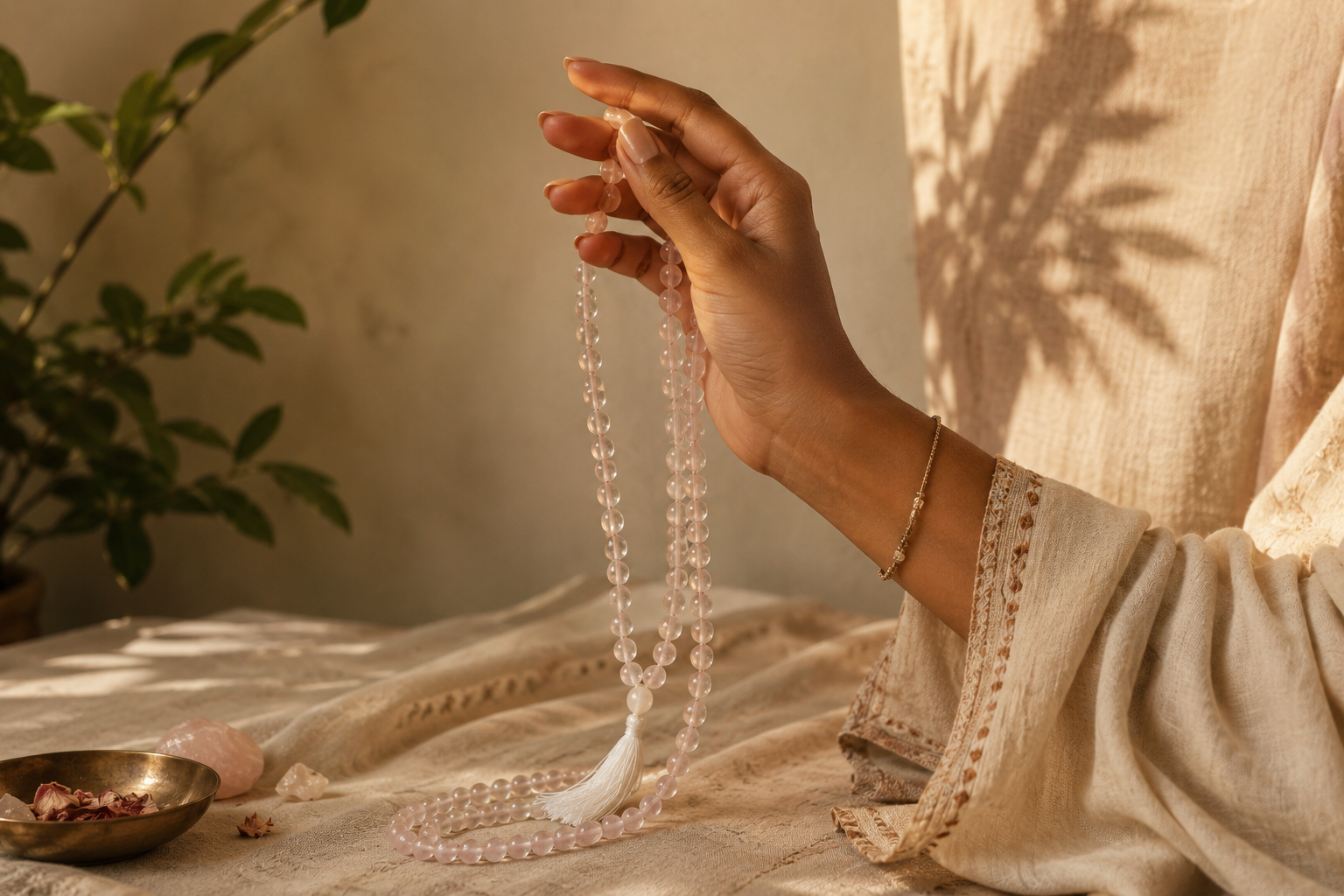
A japmala is traditionally used as a counting tool during meditation, moved bead by bead through the fingers while a mantra is recited. But many practitioners keep their mala close throughout the day, well beyond the boundaries of formal practice, choosing to wear it around the wrist, drape it around the neck, or carry it tucked into a pocket or bag. This choice, seemingly small, can shape the relationship between a person and their practice in ways that are worth considering more closely.
Wrist malas, typically shorter versions containing 27 beads, a common fraction of the traditional 108-bead japmala, have become an increasingly popular way to keep a mala present throughout daily life. Worn like a bracelet, a wrist mala sits in near-constant contact with the skin, brushing against the wrist during ordinary movements like typing, cooking, or simply resting a hand on a table.
This constant physical presence carries a particular kind of intimacy. Because the mala remains visible and touchable throughout the day, many practitioners find that it serves as a frequent, almost accidental reminder of their intentions or practice, even during moments that have nothing to do with formal meditation. A glance down at the wrist while waiting in line or a passing brush of the beads while reaching for a cup of coffee can offer a small return to presence, a momentary pause within an otherwise busy stretch of time.
The shorter bead count of a wrist mala also changes its practical use somewhat. While it remains possible to count mantra repetitions using a 27-bead mala, most practitioners either complete four full passes to reach 108 or simply use the wrist mala for shorter, informal counting sessions rather than a full formal practice. Some practitioners keep a separate, full-length 108-bead mala specifically for seated meditation while reserving the wrist mala for everyday wear and lighter, more spontaneous use throughout the day.
Material considerations become particularly relevant for wrist malas given their near-constant contact with skin. Stretch cord designs allow for easy removal and flexibility around different wrist sizes, though some practitioners prefer knotted designs between each bead, valued both for their traditional construction and for the slight resistance they offer when counting, which can make each bead easier to distinguish by touch alone.
A full-length 108-bead japmala worn around the neck carries a different kind of presence altogether. Rather than the frequent, almost incidental contact of a wrist mala, a neck mala tends to rest quietly against the chest, often hidden beneath clothing, offering a more private and less constantly noticeable form of connection throughout the day.
This placement carries its own symbolic resonance in various traditions, given the proximity to the heart center, sometimes described in yogic and meditative traditions as a location associated with compassion, connection, and emotional presence. Whether or not a practitioner subscribes explicitly to this symbolic framework, many report that wearing a mala close to the chest creates a felt sense of the practice being carried near something emotionally significant, rather than simply worn as an accessory.
Because a full 108-bead mala tends to be longer and more substantial than a wrist version, neck malas are sometimes reserved for specific occasions, such as travel to a retreat, participation in a ceremony, or periods of particularly intensive practice, rather than being worn as a constant daily accessory. Other practitioners do choose to wear their full mala daily, finding that the weight and length become a familiar, grounding presence over time, similar to how a long-worn piece of jewelry can begin to feel like an extension of the body itself rather than something separate and noticeable.
Practical considerations matter here too. A longer mala worn around the neck can catch on clothing or become tangled during physical activity, leading some practitioners to remove it during exercise, sleep, or manual labor and reserve it specifically for quieter portions of the day when it can be worn without concern for damage or discomfort.
Carrying a japmala in a pocket or small bag rather than wearing it on the body offers yet another relationship to the practice, one defined less by constant physical contact and more by intentional retrieval. A pocket mala waits until specifically called upon, whether during a quiet moment on a commute, a brief pause between meetings, or a private moment carved out during a busy day.
This mode of carrying can suit practitioners who prefer to keep their mala reserved specifically for moments of deliberate practice rather than blending into everyday wear. Reaching into a pocket to retrieve the mala becomes its own small ritual gesture, a deliberate choice to step, even briefly, into a different mode of attention. Some practitioners describe this deliberateness as valuable precisely because it maintains a clearer boundary between ordinary time and practice time, compared to a mala worn continuously on the body which may, for some, begin to blend into the background of daily awareness rather than remaining a distinct and noticed presence.
Pocket carrying does introduce its own practical concerns, particularly around potential damage to delicate beads from friction against other pocket contents such as keys or coins. Many practitioners who favor pocket carrying choose to keep their mala in a small protective pouch, which also helps maintain a sense of the mala’s significance by preventing it from being treated as an incidental object alongside everyday items.
It is worth acknowledging directly that there is limited formal research examining whether the specific way a mala is carried meaningfully changes the psychological or spiritual effects of using it. Much of what has been shared here draws on practitioner reports, traditional teachings, and general principles from research on habit formation and embodied cognition rather than direct scientific study of mala carrying specifically.
That said, the broader psychological literature on habit formation does support the general principle that frequency and context of contact with an object can influence how strongly that object becomes associated with a particular mental state or intention. A wrist mala, given its constant contact throughout the day, may naturally accumulate more frequent, if briefer, moments of conscious noticing compared to a mala reserved for pocket carrying and retrieved only during dedicated practice time. Neither pattern is inherently superior, and the right choice likely depends on what a given practitioner is hoping to cultivate, whether that is frequent small reminders throughout an ordinary day or a clearer, more protected boundary around dedicated practice time.
Ultimately, the decision of where to carry a mala may come down to a combination of practical circumstances and personal preference regarding how present the practitioner wants their practice to feel throughout the day. Some practitioners experiment across different placements over time, perhaps wearing a wrist mala during a particularly demanding season of life when frequent small reminders feel valuable, then shifting to a pocket-carried mala during a period when clearer boundaries around practice time feel more supportive.
There is no fixed rule dictating the correct way to carry a mala, and traditions themselves vary considerably in their guidance on this matter. What seems to matter most is that the chosen method of carrying supports rather than hinders the underlying intention behind the practice, whether that intention involves frequent grounding throughout a busy day or a more protected, deliberate return to stillness during specific dedicated moments.
If you are exploring a meditation practice, discover our collection of 108-bead japmalas, 27-bead wrist malas, and handcrafted meditation beads designed to support mindfulness, mantra practice, and intentional living wherever your day takes you.
Our offerings—ceremonial cacao, crystals, candles, and journals—are designed to support mindfulness, self-connection, and sacred daily rituals. Every product is ethically sourced, handcrafted with care, and infused with meaning to help you slow down, tune in, and create moments of presence.
© 2025 All rights reserved Conscious Collective