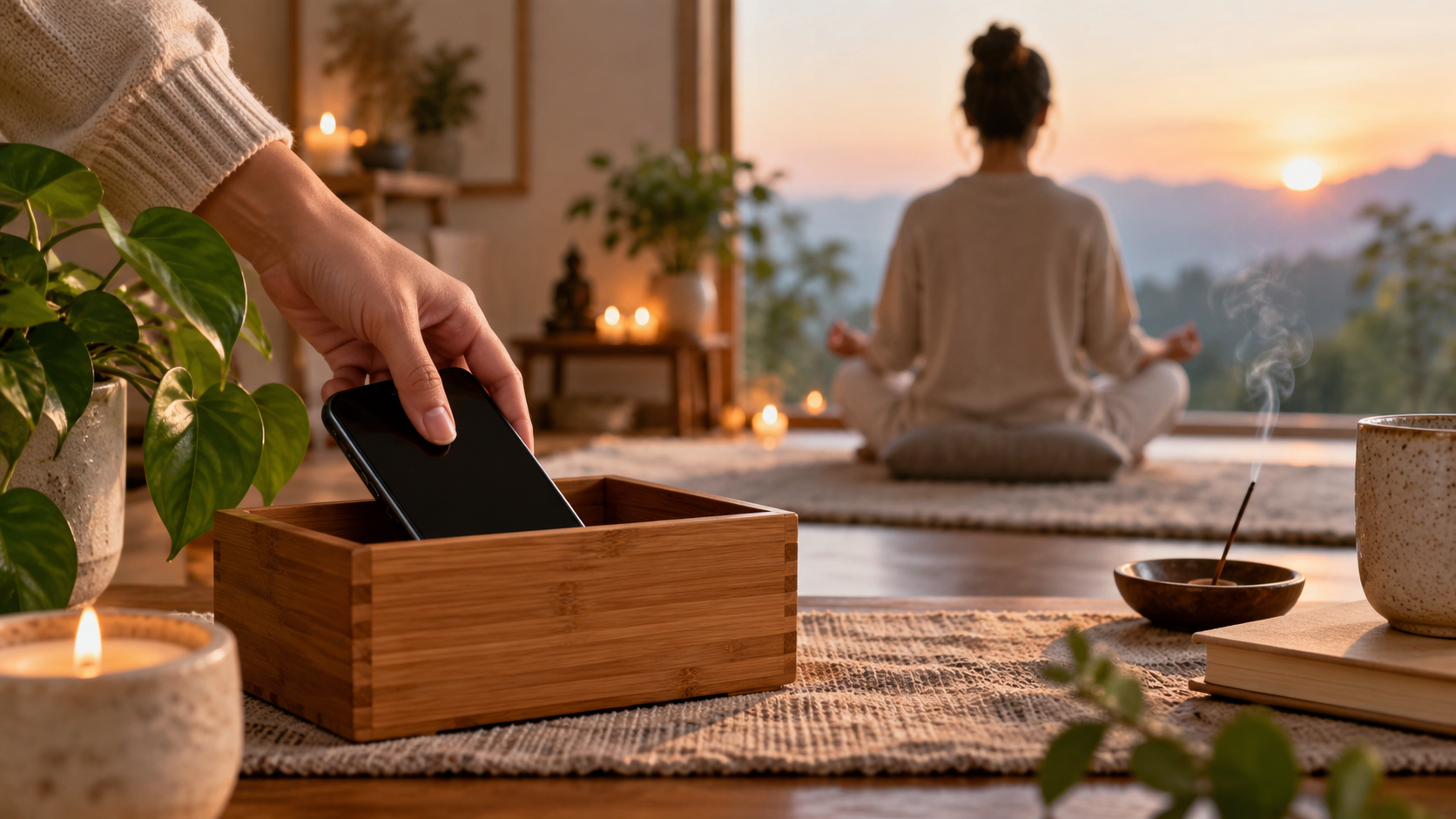
Many wellness guides mention putting the phone away before a ritual, almost as an afterthought, a small housekeeping step before the real practice begins. But it may be worth considering that this act is not simply preparation. It could be one of the most meaningful parts of the ritual itself.
A Habit That Fills Every Gap
Phones have a way of filling any available silence. A minute of waiting, a pause between tasks, even a few seconds of stillness while cacao is warming on the stove can quietly become an opportunity to check a screen. This is not necessarily a failure of willpower. Phones are built to be reached for, and the habit of picking one up during any lull may form without much conscious decision at all.
Because of this, a ritual that does not clearly separate itself from the phone may end up absorbed into the same scattered pattern as the rest of the day. Sipping cacao while scrolling, or holding a mala while glancing at a notification, may technically still be a ritual in form, but it may lose much of what made the practice meaningful in the first place.
Presence May Require an Absence
The idea of living consciously, which so much of ritual practice is built around, may depend on the ability to be with one thing at a time. A phone, even when silent and face down, can still pull a small portion of attention toward it. Its presence alone may be enough to keep part of the mind on standby, waiting for the next buzz or light.
Putting the phone in another room, rather than simply turning it face down nearby, may create a more complete kind of quiet. Some people notice that the first few minutes without their phone can feel oddly uncomfortable, almost like something is missing. This discomfort may actually be useful information, since it can reveal how automatic the habit of checking has become.
What Digital Silence Might Offer a Ritual
When the phone is truly out of reach, a few things may start to happen. The senses may become more available, since there is no visual pull competing for attention. A cup of cacao may taste more distinct, the texture of a crystal in the palm may feel more noticeable, the scent of incense may register more fully. None of this requires effort. It may simply be what happens when one less stimulus is present.
There can also be more room for the mind to wander in its own way, rather than being redirected by outside input. Thoughts that would normally be interrupted by a glance at a screen may be allowed to finish. Some people describe this as the difference between a thought that gets cut off midway and one that gets to unfold fully.
A Ritual as a Boundary, Not Just a Practice
Setting the phone aside before beginning cacao, crystal or japmala practice may function as a kind of boundary, a way of saying that this particular stretch of time belongs to something other than constant availability. In a life where being reachable at all hours has become normal, choosing a short period of digital silence may feel like a small act of reclaiming attention.
This boundary does not need to be extreme or lengthy to matter. Even ten or fifteen minutes without a phone nearby may be enough to notice a shift in how the ritual feels. The goal is not necessarily to disconnect from technology altogether, but to create pockets of time where the mind is not being pulled in multiple directions at once.
Making the Absence Easier
For some, simply deciding to leave the phone in another room may be enough. Others may find it helpful to build a small step into the ritual itself, such as placing the phone in a specific drawer or box as part of preparing the space. This can turn the act of putting the phone away into part of the ritual’s opening sequence rather than a separate rule to remember.
It may also help to be honest about how long a stretch of digital silence feels realistic. Someone new to the idea may start with five minutes and build from there, rather than expecting a full hour of uninterrupted stillness right away. There is no fixed timeline that needs to be followed, and the length of the pause may matter less than the consistency of returning to it.
Why This May Matter More Now Than Before
Many of the objects central to conscious living practices, cacao, crystals, japmalas and incense, developed long before constant connectivity existed. Their slow pace may stand in direct contrast to how most of the day is now spent. Bringing digital silence into these practices could be less about rejecting modern life and more about creating brief spaces within it where a different pace is allowed to take over.
A ritual practiced with a phone nearby may still offer some benefit, but a ritual practiced without one may reach a little deeper. The absence of the phone might not be a small detail tucked into the instructions. It may be one of the reasons the ritual works at all.