For many people, ritual can feel more meaningful when it is tied to something larger than a personal to do list. The moon, with its steady and visible cycle, may offer a natural rhythm to anchor a home practice to. This does not need to involve strict belief in astrology. It may simply be a way of using a recurring, observable pattern to bring structure and intention into how cacao and crystals are used at home.
There is something comforting about having a rhythm that exists outside of our schedules. Work calendars change, weekends disappear quickly and personal routines can become difficult to maintain when life gets busy. The moon, however, continues through its phases regardless of whether we remember to pay attention.
Using lunar phases as part of a personal ritual does not have to mean following a complicated spiritual system. It can simply create two moments in the month when we intentionally pause. One can become a moment for beginning, while the other becomes an opportunity to reflect, release and notice what has changed.
For someone already drawn to cacao, crystals, meditation or other forms of intentional practice, the lunar cycle can become a gentle framework rather than another routine to keep up with.
Why a Cycle May Help
Daily rituals can sometimes lose their meaning through repetition. Doing the same thing every single day may eventually start to feel mechanical rather than intentional. A monthly rhythm, on the other hand, can offer natural checkpoints. The new moon and the full moon, roughly two weeks apart, may create a gentle structure that invites reflection without demanding daily effort.
Some people find that having these two points in the month gives them permission to pause and check in with themselves, almost like a personal season within a season. Whether or not the moon itself has any measurable effect on mood or energy is not something that needs to be settled here. What may matter is that its visible phases offer a shared, external marker that many people already notice in passing.
The value may come from what we do with that marker. A full moon does not have to make us feel a certain way, and a new moon does not have to mean that we suddenly know exactly what we want next. Instead, these phases can simply become reminders to stop moving for a moment and ask a few honest questions.
What am I beginning?
What am I ready to leave behind?
What has changed since the last time I paused?
What needs my attention now?
The answers may be different every month. That is part of the practice.
New Moon: A Quiet Beginning
The new moon is often associated with starting points, since the sky appears dark and the cycle is technically beginning again. For a home ritual, this phase may be a fitting time to set an intention, however small.
A simple new moon practice could include the following steps.
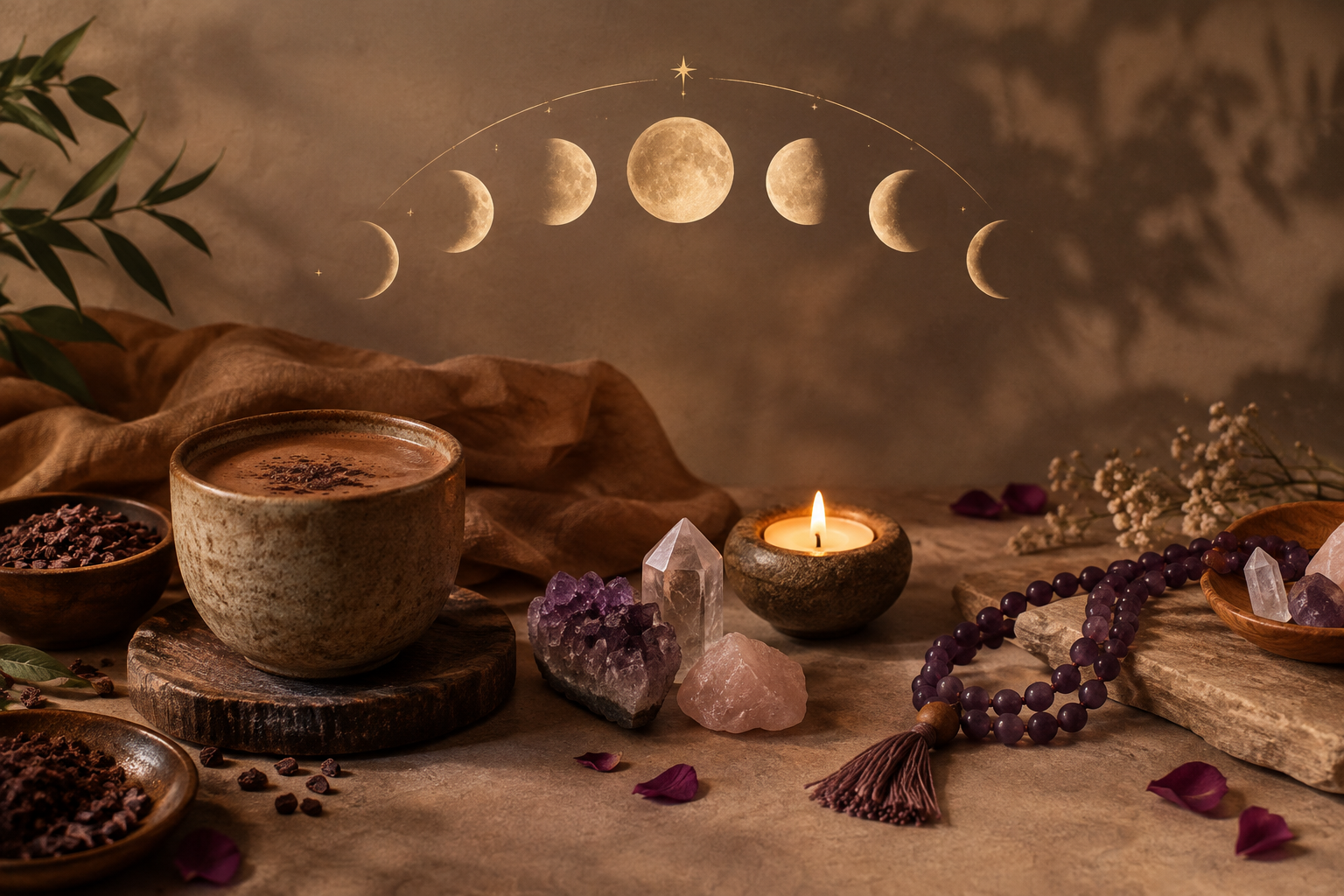
Preparing a cup of cacao slowly, perhaps in dim light or candlelight, and sitting with it before writing down or simply thinking through one intention for the coming weeks. Holding a crystal that feels connected to clarity or new beginnings, such as clear quartz, while doing this. Some people also choose to cleanse or reset their crystal bracelets around this time, wiping them down or setting them in sunlight the following morning as a way of marking a fresh start.
None of this needs to be elaborate. The intention does not need to be a grand life goal. It could be as simple as wanting to feel calmer during a busy work period or wanting to speak more gently to oneself.
An intention can also be something that is felt rather than achieved. Instead of deciding to complete a particular task, someone might choose to create more space, listen more carefully or become more present in everyday moments.
This can change the way cacao is approached too. Rather than drinking it quickly while answering messages or moving between tasks, the new moon can become an invitation to slow down. Preparing the cup becomes part of the ritual. Sitting with the warmth becomes part of it. Even a few minutes of quiet before returning to the rest of the evening can be enough.
The crystal does not need to have a predetermined meaning either. Clear quartz may be chosen for its association with clarity, while another crystal may simply be meaningful because of how it looks, feels or connects to a particular memory. Personal meaning can be enough.
Full Moon: A Moment to Release
Roughly two weeks later, the full moon may offer a natural counterpoint to the new moon’s beginning. Many traditions treat this phase as a time for release, for noticing what has built up and letting some of it go.
A full moon ritual might look like preparing cacao as usual, then spending a few minutes reflecting on what has happened since the new moon. This could involve naming something that felt heavy or unresolved, either silently or on paper. Holding a crystal associated with grounding or release, such as rose quartz or black tourmaline, may accompany this reflection.
Some people also like to set crystals or bracelets outside under the moonlight overnight during this phase, treating it as a symbolic reset for the object, separate from any claim about what that process may or may not do on an energetic level.
The release itself can be very simple. It might mean acknowledging a thought that has been taking up too much space, recognising a habit that no longer feels supportive or accepting that something did not unfold as expected.
There is no need to force a dramatic sense of closure. Sometimes release simply means admitting that something was difficult. Sometimes it means deciding not to carry a particular worry into the next few weeks. Sometimes it means recognising that we have already changed and no longer need to hold ourselves to an older version of who we were.
The full moon can therefore become less about getting rid of something and more about noticing what is already ready to loosen.
Keeping the Practice Loose
It may help to think of this lunar rhythm as a loose container rather than a strict calendar. Life does not always align neatly with the sky, and a full moon might fall on the busiest day of the month. Rather than forcing an elaborate ritual on that exact date, the practice can simply be moved to the nearest quiet evening. What may matter is the intention behind the practice, not perfect timing.
Some people also choose to only mark one phase rather than both. Focusing solely on new moon intentions, for example, may suit someone who finds the idea of releasing overwhelming or unclear. There is no requirement to observe every phase to benefit from having some rhythm at all.
The practice can also change depending on the season of life. During a particularly busy month, the entire ritual might take ten minutes. During a quieter period, it might involve journaling, meditation, preparing cacao slowly and spending more time with a crystal or japmala.
There is freedom in allowing the ritual to remain flexible. A practice that adapts to real life is often easier to return to than one that requires perfect conditions.
A Practice Without a Fixed Belief System
One of the more approachable aspects of lunar based ritual may be that it does not require a person to hold any particular belief about the moon’s influence. It can simply be used as a memory device, a recurring cue that says it is time to check in with intentions and feelings. In the same way that a birthday marks a yearly moment of reflection, the new and full moon can mark a monthly one.
For those who already enjoy cacao and crystal practices, adding this rhythm may offer a way to notice change over time. Looking back at what was intended during one new moon and comparing it to how things unfolded by the full moon can offer a small, personal record of growth, even if it is never written down formally.
The practice can also be completely personal. One person may use cacao as the centre of the ritual. Another may prefer a crystal bracelet, a japmala or a few minutes of journaling. Someone else may simply sit near a window and observe the moon.
There is no need to make the ritual look a certain way for it to be meaningful.
Creating Your Own Lunar Ritual
A simple practice could begin with choosing one object and one question for each phase.
For the new moon, prepare your cacao, hold a crystal and ask yourself what you would like to nurture over the coming weeks.
For the full moon, prepare another cup, hold the same crystal or choose another one and ask yourself what you have learned and what you are ready to loosen your grip on.
Keeping the same object throughout the month can create continuity. Alternatively, choosing different crystals based on what feels relevant can make the practice more intuitive and responsive.
You might also keep a small lunar journal. One page can be dedicated to each new moon and full moon. There is no need to write pages of reflection. A few sentences about what you are feeling, what you are hoping for and what you are noticing can become surprisingly meaningful when read months later.
Over time, the ritual becomes less about the moon itself and more about the relationship you build with your own attention.
Letting the Sky Be a Gentle Reminder
At its simplest, this practice may just mean noticing the moon a little more. A glance out the window on a clear night, a small pause with a cup of cacao, a moment spent holding a familiar crystal. These are not large commitments. They may simply offer a reason to return to stillness twice a month, using something as old and constant as the moon to remember that presence does not need to be earned through effort. It can be as simple as looking up.
The beauty of a lunar ritual may be that nothing needs to be forced. The moon does not ask us to become someone different overnight. It simply keeps moving through its phases, offering a recurring reminder that beginnings, fullness, endings and beginnings again are all part of being alive.
Perhaps that is what makes the cycle worth returning to.
Not because the moon has to tell us what to do, but because looking up can remind us to ask ourselves what we need.