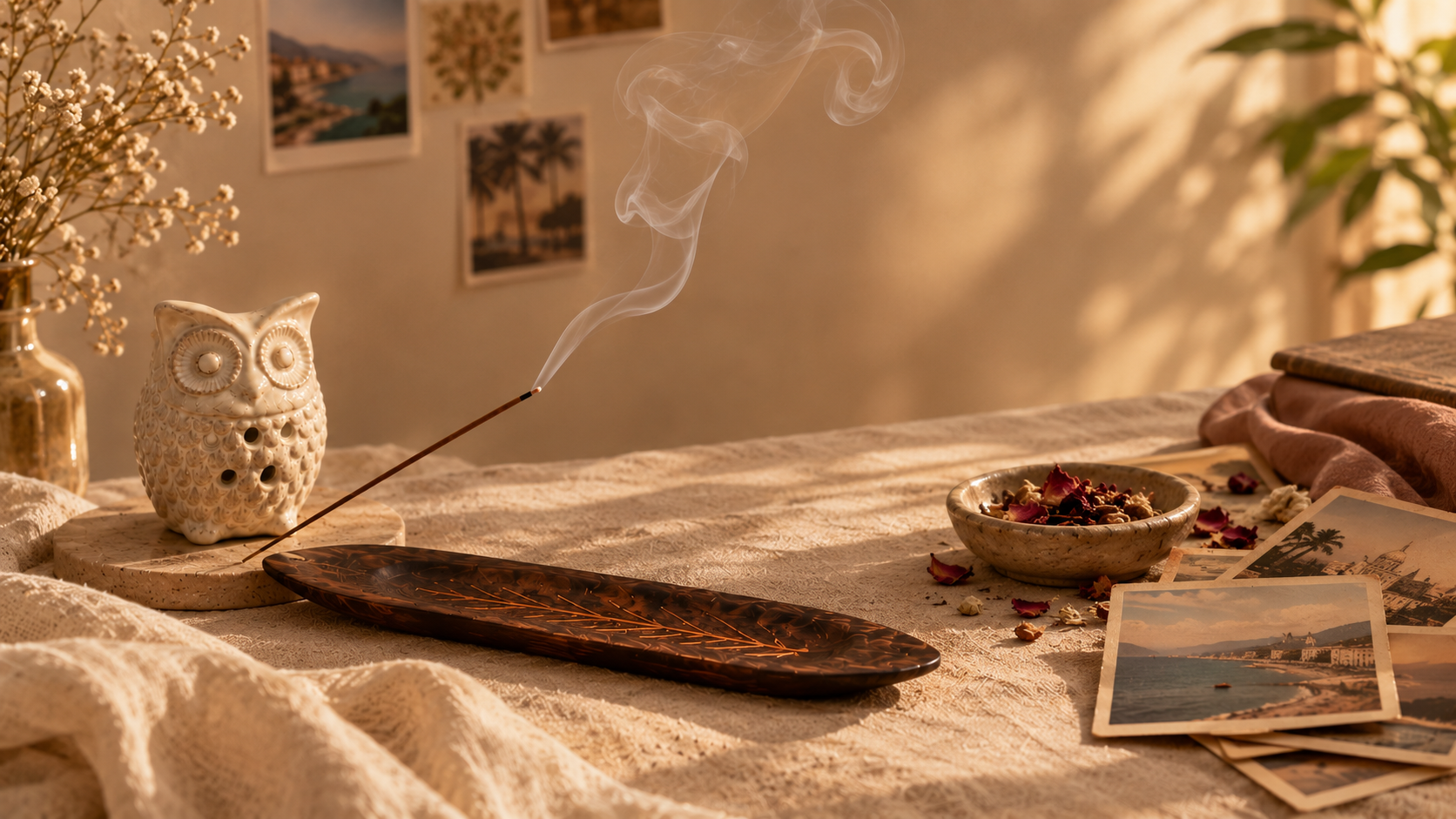
You might be walking through an unfamiliar street when the smell of incense suddenly reminds you of your childhood home. Perhaps a particular fragrance brings back memories of a family gathering, a favourite holiday destination, or someone you have not seen in years. The memory may arrive unexpectedly. You were not deliberately thinking about that person or place, yet a familiar scent seems to bring the experience back into your awareness. Sometimes, the association can be so specific that you remember details you had not thought about for a long time. Why do certain smells seem to have such a personal connection with our memories? Our sense of smell has some fascinating relationships with the brain systems involved in memory and emotion. However, the experiences we associate with particular fragrances can vary considerably from person to person. A scent that feels comforting to one individual might remind someone else of an entirely different experience.
Many of us grow up surrounded by fragrances that gradually become part of our understanding of home. These might include the smell of freshly prepared food, rain falling on warm ground, a family member’s perfume, or incense burning in another room. We may not pay much attention to these fragrances while experiencing them regularly. They simply become part of the background of everyday life. But after moving away or spending a long period in a different environment, encountering the same scent might bring back unexpectedly vivid memories. Someone who grew up in a household where incense was frequently used may associate a particular fragrance with mornings at home. Another person might connect the same scent with visiting their grandparents or attending a family celebration. These associations can develop without deliberate effort. Repeated experiences may gradually create connections between particular smells and the environments in which we encounter them. Years later, those connections might influence how we respond when we recognise a familiar fragrance.
Our sense of smell works differently from some of our other sensory systems. When we encounter an odour, specialised receptors in the nose detect airborne molecules and send signals to the olfactory bulb. The olfactory system has close anatomical connections with brain regions involved in memory and emotion, including parts of the amygdala and the entorhinal cortex. These connections may help explain why certain smells can evoke vivid autobiographical memories. However, this does not mean that every fragrance will produce a strong emotional response or that smell always creates more accurate memories than other senses. Our experiences can be influenced by familiarity, personal associations, attention, and the circumstances in which we encounter a scent. A particular fragrance may remind you of a specific person because you frequently experienced that smell in their presence. Over time, the two experiences may have become associated with one another. This can make scent an interesting way to explore our personal histories.
Imagine two people encountering the fragrance of sandalwood incense. One person might associate it with family gatherings and familiar surroundings. The other may remember a particular hotel, a holiday, or an unpleasant experience involving a strong fragrance. Although they are smelling the same thing, their emotional responses may be completely different. This suggests that our reactions to fragrance are not determined solely by the chemical properties of the scent itself. Personal history, cultural context, and previous experiences can also influence our associations. Some fragrances may be widely recognised within particular communities because of their use in religious, cultural, or domestic settings. However, the meaning attached to those fragrances may still vary between individuals. A smell that one person considers deeply nostalgic might feel entirely ordinary to someone else. This can be particularly interesting when choosing fragrances for a shared living space. The incense you enjoy may not necessarily be the fragrance your partner, roommate, or family members prefer.
Have you ever recognised someone’s perfume before seeing them? Perhaps a friend has worn the same fragrance for years, or a family member regularly uses a particular scented product. Over time, the smell may become so closely associated with that person that encountering it elsewhere reminds you of them. The same experience might occur with familiar household fragrances. Someone may remember a grandparent through the smell of incense, a particular soap, or the spices used in their kitchen. These associations can sometimes continue long after the person is no longer part of our everyday life. They may evoke happiness, nostalgia, sadness, or a mixture of different feelings. Not every scent-related memory is necessarily pleasant. A fragrance associated with a stressful or difficult experience might also produce an uncomfortable reaction. This is one reason it can be helpful to avoid assuming that particular fragrances will have universally calming or uplifting effects. Our personal experiences may be more influential than the popular meanings attached to individual scents.
Certain spaces can develop a distinctive sensory character. A favourite bookstore might have the familiar smell of old paper, while a particular café may be associated with freshly ground coffee. Similarly, a home in which incense is frequently used might develop a recognisable fragrance. Over time, people who regularly visit that space may begin to associate the scent with the environment. The fragrance may eventually become part of what makes the place feel familiar. This does not necessarily require an elaborate practice or a particular intention. Repeated exposure can sometimes be enough to create an association. For example, you might use a particular incense fragrance in your living room for several months. If you later encounter that scent in another location, it may remind you of your home. However, it is worth remembering that burning incense produces smoke and airborne particles. Good ventilation is important, and people with respiratory sensitivities may prefer to avoid it. The emotional associations we form with fragrance do not depend on exposing ourselves to smoke. Other scented objects or familiar household aromas may create similar personal associations.
Just as our preferences for food, music, and clothing may change, the scents we enjoy can also evolve. You might have loved floral fragrances as a teenager but now prefer woody or earthy aromas. Alternatively, a scent you once disliked may gradually become appealing because of a positive experience associated with it. Our preferences may be influenced by repeated exposure, changing environments, and the memories we develop over time. Sometimes, a fragrance can become less appealing precisely because it reminds us of a period we would rather leave behind. A perfume associated with a previous relationship might feel different after that relationship ends. Similarly, a fragrance encountered during a memorable holiday may remain appealing long after the trip. These changes do not necessarily reveal anything definitive about our emotional state. They may simply reflect the evolving relationship between our senses and our experiences.
When choosing incense or other scented products, it can be tempting to rely on descriptions that promise particular emotional experiences. Some fragrances are marketed as calming, energising, or spiritually cleansing. However, our individual responses may differ from these descriptions. You might find a traditionally relaxing fragrance unpleasant, while a scent associated with alertness feels comforting because it reminds you of home. Rather than choosing a fragrance solely for its advertised effects, you could consider what you genuinely enjoy. Do you prefer warm, woody scents or something light and floral? Are there particular fragrances that remind you of meaningful places or people? You may discover that your favourite scent has very little to do with its commonly described properties. Its appeal might come from an association that belongs entirely to you. And perhaps that is what makes the relationship between scent and memory so interesting. Explore our collection of incense holders and discover pieces for the fragrances you enjoy by clicking the image below.

Our offerings—ceremonial cacao, crystals, candles, and journals—are designed to support mindfulness, self-connection, and sacred daily rituals. Every product is ethically sourced, handcrafted with care, and infused with meaning to help you slow down, tune in, and create moments of presence.
© 2025 All rights reserved Conscious Collective