When you look at a crystal bracelet, you might notice its colour, the smoothness of its beads, or the way it catches the light. You may be drawn to the deep purple of Amethyst or the delicate pink of Rose Quartz without giving much thought to where those stones originally came from. But long before a crystal becomes a bracelet, a decorative object, or a piece of jewellery, it has already been on quite an extraordinary journey. Some crystals may have formed millions of years ago, undergone significant geological changes, and travelled through several countries before reaching the person who eventually owns them. Behind their polished appearance can be a fascinating combination of natural history, craftsmanship, trade, and human effort. Understanding this journey might offer a different perspective on the crystals we choose to purchase and the stories that accompany them.
Crystals are formed through natural geological processes that can take place under very different environmental conditions. Some develop when molten rock cools, while others form when mineral-rich fluids move through cracks and cavities in existing rocks. Temperature, pressure, chemical composition, and the availability of particular elements can influence which minerals form and what they eventually look like. Quartz, for example, is a mineral found in many geological environments. Different varieties may develop distinctive colours because of trace elements, inclusions, or other processes. Amethyst gets its characteristic purple colour through processes involving iron impurities and natural irradiation. Rose Quartz is known for its delicate pink appearance, while Citrine may display shades ranging from pale yellow to warm orange. Although we often see these stones neatly arranged in jewellery collections, their original forms can be quite different. A crystal that eventually becomes a smooth, round bead may initially have been part of a much larger mineral formation. Some specimens may contain irregular surfaces, natural fractures, or variations in colour that are removed or altered during processing. The polished bracelet we see in a shop is therefore only one stage in a much longer story.
Crystals are sourced from different parts of the world, depending on the mineral and the geological conditions required for its formation. Brazil, Madagascar, India, Zambia, and several other countries are associated with the production of different gemstones and mineral specimens. However, the country in which a crystal is purchased does not necessarily indicate where it was originally mined. A stone may be extracted in one country, processed in another, and sold through distributors operating elsewhere. This can make tracing its complete journey surprisingly complicated. For example, rough mineral material might be purchased by a wholesaler before being sent to a workshop where it is cut, shaped, polished, and prepared for jewellery production. The finished beads may then pass through additional suppliers before reaching a retail collection. Each stage can involve different businesses and workers. For someone purchasing a crystal bracelet, this entire process may remain largely invisible. Learning about the possible origins of crystals can encourage us to become more curious about the products we bring into our homes.
When we admire a finished crystal bracelet, it can be easy to overlook the work involved in producing it. Mining, sorting, cutting, polishing, drilling, and assembling crystal beads can all require human labour. The working conditions involved in these processes may vary considerably depending on the country, operation, and individual supplier. Some crystals may come from established mining businesses, while others may be extracted through smaller-scale or artisanal operations. Artisanal mining can provide important sources of income for local communities, although some operations may face challenges relating to workplace safety, environmental management, and fair compensation. It would be inaccurate to assume that every crystal comes from harmful conditions, just as it would be difficult to guarantee that every stone has been sourced responsibly without sufficient information. This is why transparency can be an important consideration. When businesses provide information about their suppliers and sourcing practices, customers may have a better opportunity to understand the products they are purchasing. However, even well-intentioned retailers may face limitations when tracing materials through complex international supply chains. The journey of a crystal can involve many hands, and recognising that human contribution may add another dimension to the way we appreciate these objects.
Once a mineral has been extracted, it may undergo several stages of processing before becoming suitable for jewellery. Rough stones are often sorted according to their size, colour, quality, and intended use. Some may be preserved as natural mineral specimens, while others are cut into smaller pieces for decorative objects or jewellery. For crystal bracelets, stones are typically shaped into beads before being polished and drilled. Achieving a smooth, rounded finish may require multiple stages of cutting and polishing. Depending on the mineral, the equipment used, and the desired appearance, different techniques may be involved. Natural variations in colour and pattern can also influence how stones are selected and arranged. A bracelet made from carefully matched beads might look quite different from one that celebrates more noticeable variations. Neither style is necessarily more authentic. In fact, natural minerals can display considerable diversity even when they belong to the same variety. Some stones may also undergo treatments intended to alter or enhance their appearance. Heating, dyeing, and other treatments are used within parts of the gemstone industry. These processes are not necessarily deceptive when they are accurately disclosed, but customers may reasonably prefer to know whether they are purchasing untreated or treated material.
As interest in crystals has grown, conversations about responsible sourcing have become increasingly relevant. Many people choose crystals because they associate them with nature, personal meaning, or conscious living. This may lead them to wonder whether the way a crystal was obtained aligns with those values. Ethical sourcing is not always straightforward. It can involve considerations such as workplace safety, fair compensation, environmental practices, and the transparency of supply chains. However, there is no single universal certification that guarantees every crystal sold worldwide has met all possible ethical standards. A retailer may have detailed information about one supplier but less visibility into another. For customers, asking thoughtful questions can be a useful starting point. Where does the crystal come from? Does the seller know whether it has been treated? Can they provide information about their sourcing practices? Not every question will necessarily have a complete answer. Still, greater curiosity may encourage more transparency across the industry.
Crystal jewellery is often photographed in ways that emphasise symmetry, consistent colouring, and flawless surfaces. Yet natural stones may contain inclusions, uneven colour distribution, or subtle differences in appearance. These characteristics can sometimes offer clues about the conditions under which the minerals formed. A bead with a small inclusion or unusual pattern is not automatically defective. However, visible characteristics alone cannot reliably establish whether a stone is natural, untreated, or ethically sourced. Some synthetic and treated materials can closely resemble natural gemstones. If authenticity is particularly important, information from a reputable supplier or appropriate gemological testing may be more useful than relying on appearance alone. Appreciating natural variation can nevertheless change the way we look at crystal jewellery. Instead of expecting every bead to look identical, we might begin to notice the small differences that make individual stones interesting.
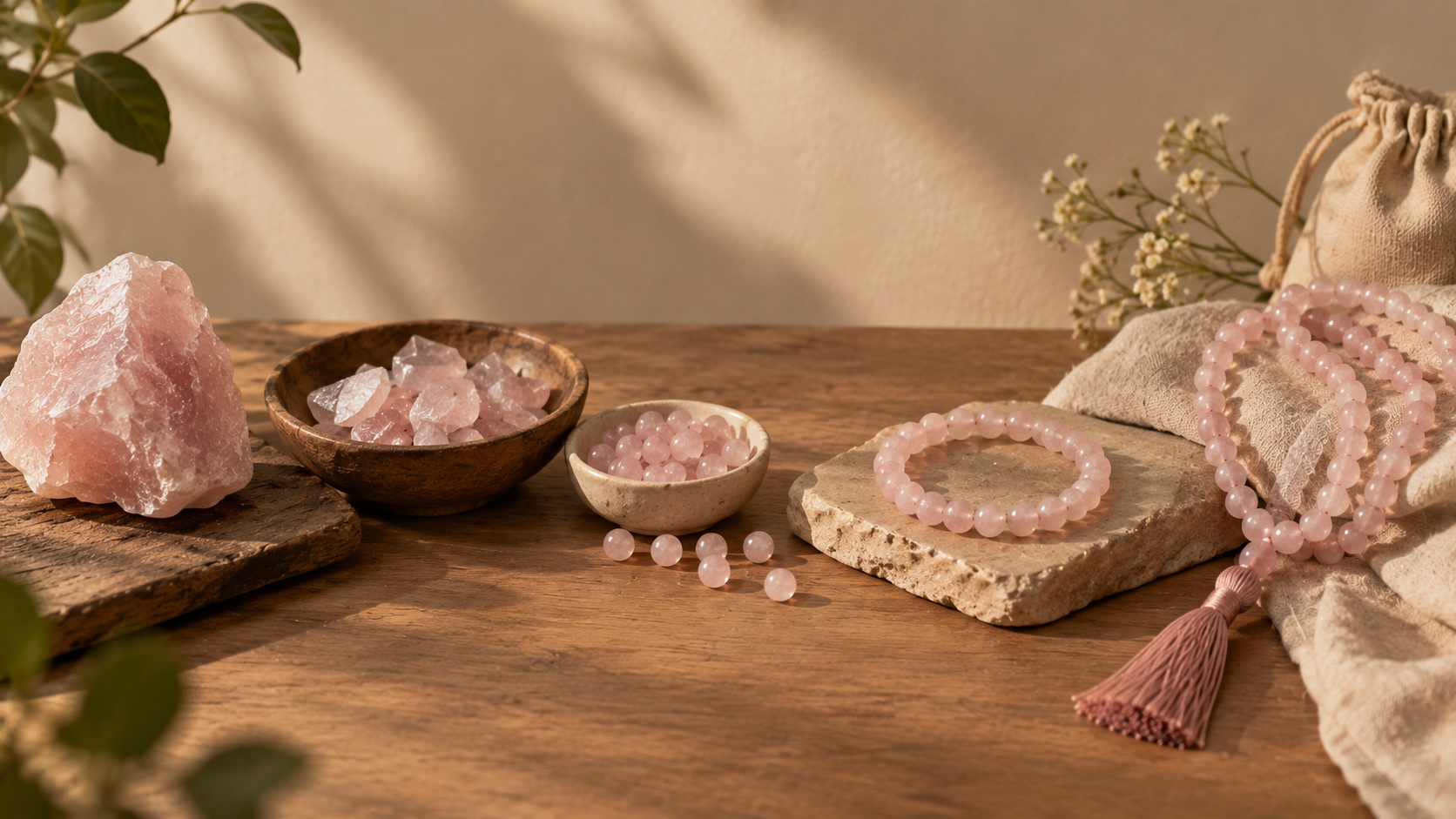
The next time you pick up a crystal bracelet, you might find yourself wondering about the journey it took before reaching you. Where did the mineral originally form? Who extracted it? How many people were involved in shaping and polishing the beads? We may never know every detail of an individual crystal’s history. But asking these questions can encourage a more thoughtful relationship with the things we purchase. A crystal can be appreciated for its appearance, personal symbolism, geological history, or the craftsmanship involved in turning it into something wearable. Sometimes, understanding even a small part of its journey might make an otherwise familiar object feel entirely different. Explore our collection of crystal bracelets and discover the natural beauty of different stones by clicking the image below.

Our offerings—ceremonial cacao, crystals, candles, and journals—are designed to support mindfulness, self-connection, and sacred daily rituals. Every product is ethically sourced, handcrafted with care, and infused with meaning to help you slow down, tune in, and create moments of presence.
© 2025 All rights reserved Conscious Collective