Introduction: Everything You’ve Ever Drunk
Take a moment to consider every beverage you’ve consumed in the past week. Coffee grabbed from a to-go cup while answering emails. Water sipped absently at your desk between tasks. Wine poured while scrolling through a screen. A smoothie consumed in the car. A tea made and then forgotten, found cold an hour later.
How many of those drinks did you actually taste? How many moments of genuine presence did they receive? How many were consumed primarily as functions — vehicles for caffeine, hydration, social ritual, or momentary comfort — rather than as experiences worth inhabiting?
For most of us in modern life, the honest answer is: very few. We consume beverages the way we consume most things in a fast-paced world — efficiently, distractedly, and with attention organized almost everywhere except the immediate sensory reality of the experience. We are drinking, technically. But we are rarely, if ever, in communion with what we drink.
The distinction between consumption and communion might sound philosophical, but its implications for daily wellbeing are deeply practical. And the practice of ceremonial cacao can be a remarkably powerful doorway into understanding that distinction from the inside.
What Is Consumption Without Presence?
Consumption without presence might be understood as the act of taking something in without genuinely receiving it. The substance — food, drink, information, experience — passes through us, but we are not actually there for it. We are somewhere else: in the planning mind, the scrolling habit, the anxious future or regretful past.
This is not a moral failing. It is largely a structural feature of how modern attention is organized. The cognitive load of contemporary life is genuinely high, and the devices and systems we have built around ourselves are specifically engineered to capture and hold attention in ways that prevent genuine presence. Absent-minded consumption is, in many ways, a predictable adaptation to an environment that doesn’t make presence easy.
But the costs may be significant. When we consume without genuine reception, we may miss the sensory richness of the experience — the full spectrum of flavor, texture, and sensation available in even the simplest foods and drinks. We might also miss the regulatory information that genuine reception provides. The body has sophisticated mechanisms for signaling satisfaction, fullness, and pleasure that may only function properly when attention is sufficiently present to receive the signal. Mindless consumption can bypass these mechanisms entirely, leaving us consuming more than we need in an attempt to satisfy a hunger that isn’t really physical.
What Communion With a Beverage Might Actually Feel Like
Communion, as used here, doesn’t necessarily carry a religious meaning — though for those for whom that resonance feels true, it need not be excluded. It might be understood simply as the quality of full, receptive, present meeting with what is being experienced. A coming into genuine contact with the thing itself rather than using it as a prop for a mental state you’re generating in parallel.
Communion with a beverage might feel like noticing the warmth of the cup before the first sip, the way it transfers through the ceramic into the palms. It might feel like attending fully to the first moment of taste — genuinely receiving the complexity of flavor without immediately categorizing it or moving past it. It might feel like following the warmth down the throat and into the chest, staying with the actual sensation rather than already thinking about the next sip.
This level of presence with a simple act of drinking may sound straightforward, but it can be surprisingly challenging to sustain — not because it requires any special skill, but because the attentional habits of modern life pull strongly in the other direction. Communion requires slowing down, which means resisting the momentum of everything that is constantly trying to accelerate your attention somewhere else. That resistance, practiced regularly, might be one of the most quietly radical acts available in contemporary life.
Why Cacao May Be a Particularly Powerful Teacher
Many beverages can be approached with the quality of attention that makes communion possible — tea, water, wine, a glass of cold water on a hot day. But ceremonial cacao may be a particularly effective vehicle for this practice for several reasons.
Its flavor is complex and not immediately easy to categorize. The bitterness, earthiness, subtle sweetness, and lingering warmth of well-prepared ceremonial cacao may reward slower, more attentive drinking in a way that simpler beverages don’t always demand. The experience keeps unfolding if you stay with it.
Its physiological effects — gentle cardiovascular opening, mild elevation of mood, deepening of body awareness through theobromine and anandamide — may make presence more accessible rather than requiring it against significant neurological resistance. The cacao, in a sense, might meet you partway.
The cultural and historical context of ceremonial cacao may also invite a different quality of attention. When you know that what you’re holding has been used for thousands of years across Mesoamerican cultures as a sacred medicine and a vehicle for deep inner work, you might find it easier to treat it as something worth full presence — rather than something to be consumed efficiently before moving on.
The Preparation as Practice
In many traditions that honor the ritual dimension of eating and drinking, the preparation is understood as an integral part of the practice — not merely a preliminary step to be completed before the real thing begins.
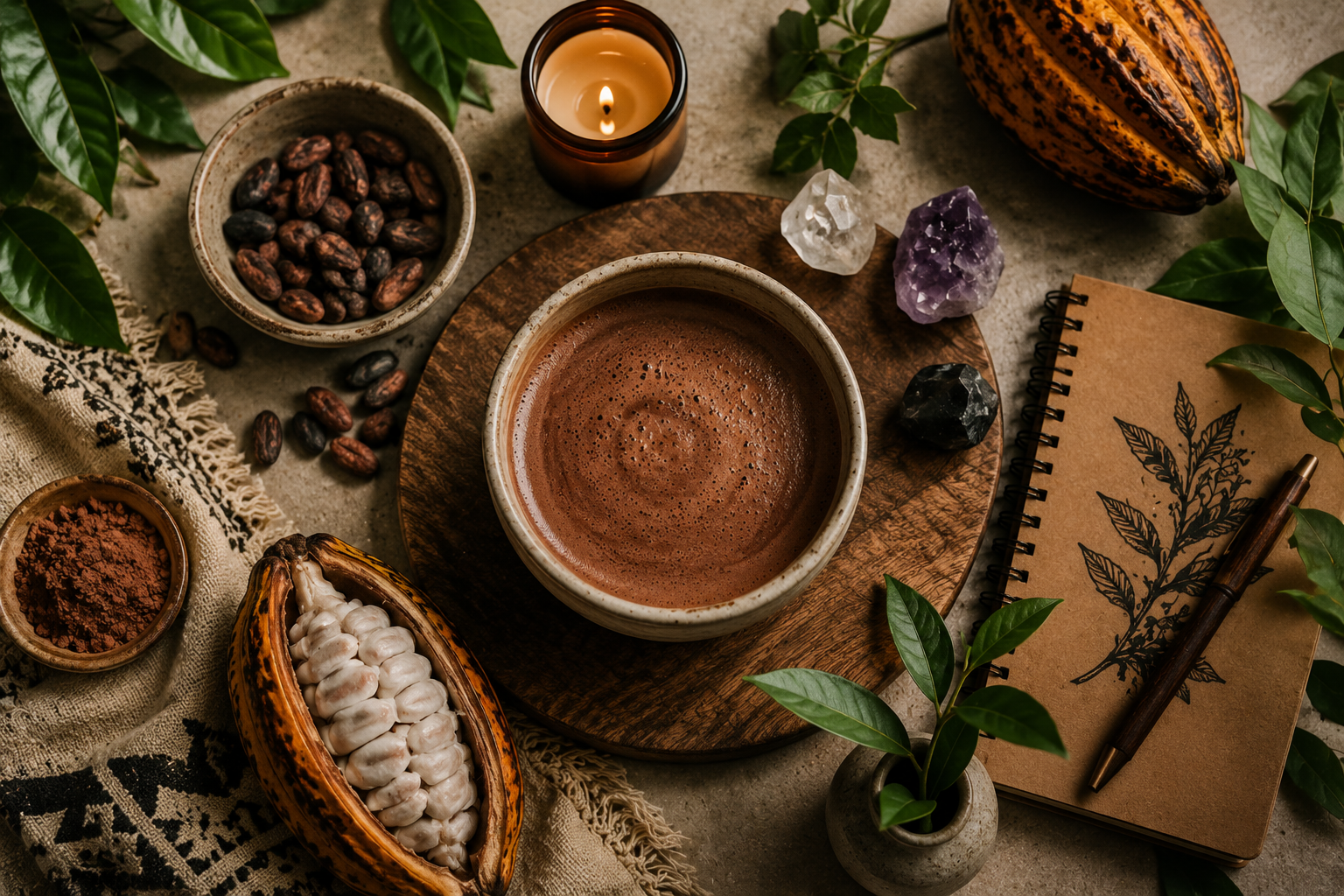
Preparing ceremonial cacao with genuine attention can be a meditation in itself. The process of breaking or measuring the cacao, heating the water to the right temperature, blending or whisking the mixture into a smooth and fragrant drink — each step can be an opportunity for sensory presence rather than habitual accomplishment.
The Japanese tea ceremony (chado) embodies this understanding beautifully: every movement in the preparation of matcha is approached with the quality of full presence, so that the ceremony begins long before the tea is drunk. The drinking itself is simply the culmination of a sustained practice of attention that has been building throughout the preparation.
Your cacao practice need not be anywhere near as elaborate as chado to benefit from this principle. Simply bringing genuine attention to the preparation — noticing the smells, the textures, the temperatures, the sounds of the process — can begin to shift the overall quality of presence you bring to the drinking itself.
Extending the Practice: From Cacao to Everything Else
The quality of presence cultivated in a mindful cacao practice may not need to stay contained within that specific ritual. One of the most interesting possibilities of a regular communion-oriented cacao practice might be that it gradually begins to influence how you relate to other acts of consumption and reception throughout your day.
People who develop a consistent mindful drinking practice often report that the attentional habits trained in that practice seem to bleed into other domains — that meals become more savored, that social conversations carry more genuine attention, that the tendency to be somewhere else while apparently doing something here gradually softens.
This might not be a dramatic or overnight transformation. It could be subtler — a slightly increased likelihood of noticing when you’re not present, which creates the opportunity to return. A slightly expanded capacity to receive sensory experience rather than consume it functionally. A slightly greater awareness of the difference between being somewhere and being fully there.
These small shifts, accumulated over time, might add up to something significant: a genuinely different quality of daily life.
Practical Guidance: Transitioning From Consumption to Communion
If you’d like to begin experimenting with this shift in your own practice, a few practical starting points might help.
Choose one beverage each day to drink with full presence. This doesn’t have to be cacao every time — though cacao may be particularly well-suited for the practice. It could be your morning coffee, a cup of herbal tea, or simply a glass of water. The content matters less than the quality of attention you bring.
Create a brief ritual of beginning. Before the first sip, pause for one conscious breath. Feel the weight of the cup. Notice the temperature. This tiny gesture of interruption may be enough to shift the register from consumption to reception.
Put down everything else. This may be the most challenging part. Drinking while reading, working, or scrolling is deeply habitual for many people. Choosing to drink with nothing else competing for your attention — even for five minutes — might reveal how much of the experience you normally miss.
Stay with the aftertaste. After each sip, pause long enough to receive the full experience before the next one. The aftertaste, the lingering warmth, the subtle shift in body state — these are all part of the experience that habitual consumption tends to override.
Conclusion: The Radical Act of Fully Receiving
In a culture organized around taking more — more productivity, more stimulation, more content, more experiences — the act of receiving more fully from less might be a quietly revolutionary practice. The shift from consumption to communion doesn’t require acquiring anything new. It simply requires bringing more of yourself to what is already here.
The cup of cacao you might hold in ceremony, the cup of tea you make on an ordinary morning, the glass of water before sleep — all of these might be, if you allow them to be, invitations into a deeper quality of presence than consumer culture usually makes available. They might be small doorways to the experience of being genuinely here, in this body, in this moment, with this life.
That experience — simple, immediate, and endlessly available — might be one of the most nourishing things accessible to us. We just may have forgotten, for a while, how to let it in.