Most ritual content tends to focus on beginnings, on setting intentions and starting fresh. Endings often get less attention, even though they may be just as important to mark. A release ritual, something built around letting go rather than starting anew, could offer a gentle structure for the moments in life that call for closure rather than a fresh start.
Why Endings May Deserve Their Own Ritual
Grief, disappointment and change do not always announce themselves clearly. Sometimes a small loss can sit quietly in the background, unacknowledged, simply because there was no obvious moment to mark it.
A release ritual may offer that moment, a deliberate pause where something can be named and, in some way, set down.
This does not need to be tied to a major life event. It could apply to something as ordinary as letting go of a plan that did not work out, a version of oneself that no longer fits or a habit that has quietly run its course.
Marking these smaller endings may matter just as much as marking the larger ones, since they can otherwise accumulate unnoticed.
Cacao as a Companion, Not a Solution
Cacao is sometimes framed as something that opens the heart, and many people who work with it describe feelings surfacing during a slow, quiet cup. Whether or not this effect can be measured scientifically, the simple act of sitting with a warm drink in a calm space may create the kind of stillness where difficult feelings are more able to rise to the surface.
For a release ritual, cacao may work best as a companion to the process rather than a fix for it.
Preparing the cup slowly, perhaps naming what is being released before the first sip, can turn an ordinary drink into a marker of the moment. There is no need to rush through the cup.
Sitting with it in silence, allowing thoughts and feelings to move without needing to resolve them immediately, may be enough.
Fire as a Symbol of Transformation
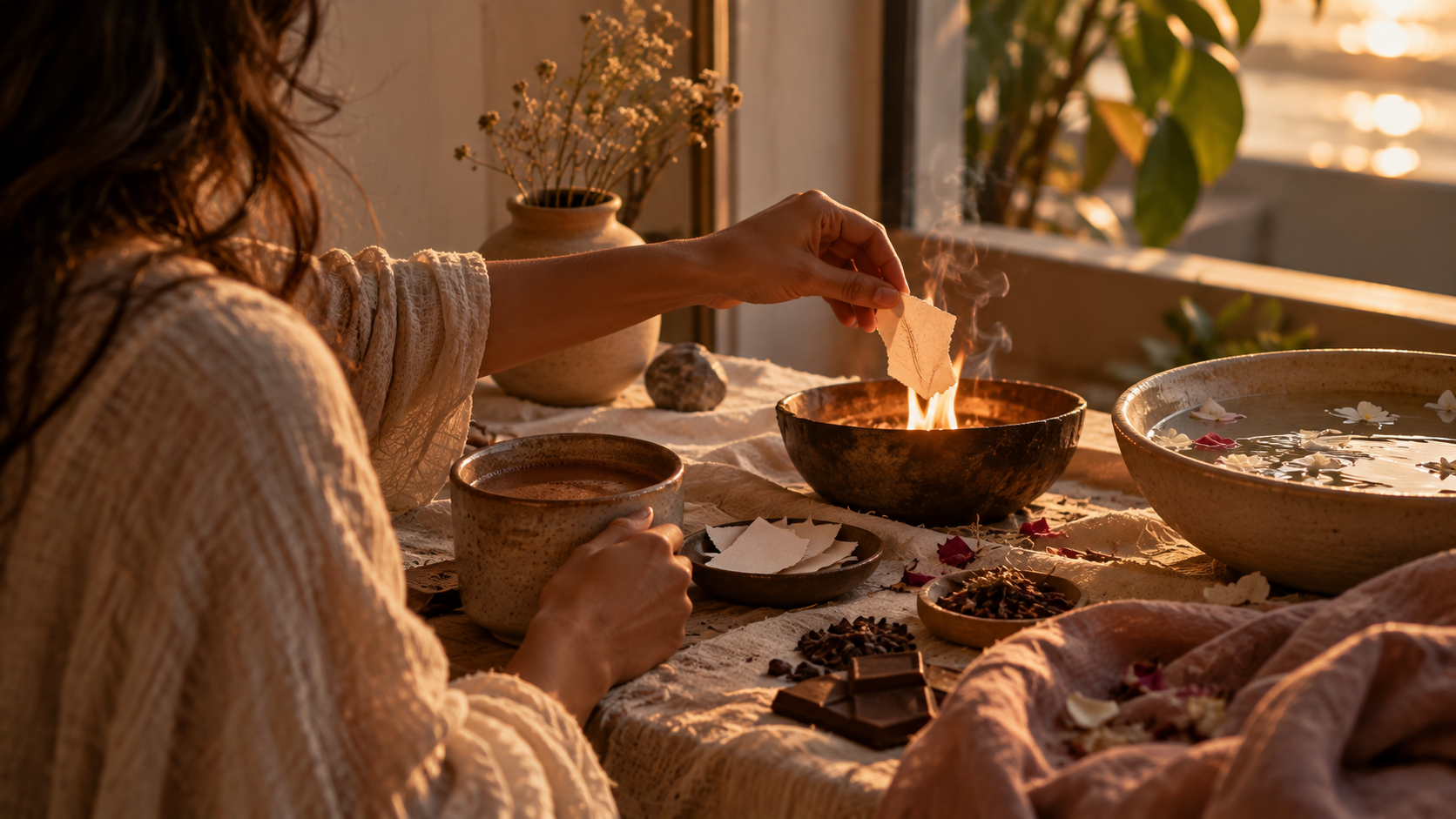
Fire has long been associated with change, since it can turn one substance into another entirely. A small, safe use of flame, such as a candle or a controlled burning of a piece of paper on which something has been written, may serve as a physical gesture that mirrors an internal process.
For those who choose to write something down before burning it, the words do not need to be elaborate. A single sentence naming what is being let go of, or even just a word, may be enough.
Watching the paper burn, if done safely in a fireproof container or outdoors, can offer a visual representation of transformation that words alone might not provide.
Some people prefer simply lighting a candle and watching the flame for a few minutes without any additional action, treating the fire itself as a quiet witness to the release rather than requiring anything to be burned.
Water as a Symbol of Cleansing
Where fire may represent transformation, water is often associated with washing away or carrying something downstream.
A release ritual built around water could be as simple as running the hands under a tap for a minute while silently acknowledging what is being released, or taking a slow bath or shower with the specific intention of letting something go.
For those near a natural body of water, some choose to release a small biodegradable item, such as a flower petal, into a stream or the sea, watching it drift away as a physical representation of release.
This is not necessary for the ritual to be meaningful. Even standing at a sink with warm water running over the hands may offer a similar sense of closure.
Building a Simple Release Ritual
A release ritual does not need to be complicated to be effective. A simple structure might look something like this:
- Prepare a quiet space free from immediate distractions.
- Sit with a cup of cacao and allow a few minutes to notice what feels heavy or unresolved.
- Name what you are releasing, either silently, aloud or in writing.
- Choose fire or water as the closing gesture, whichever feels more fitting for what is being released.
- Sit for a few more minutes afterward before returning to regular activity.
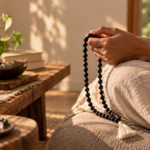
This structure can be adjusted freely. Some may prefer to skip the cacao and go straight to the symbolic gesture. Others may want to add a japmala or a crystal into the mix, using it as an object to hold throughout the process.
There Is No Wrong Way to Release Something
It may help to remember that a release ritual does not need to feel dramatic or produce an immediate sense of closure.
Some releases happen gradually, over several sittings, rather than all at once. Returning to the ritual more than once for the same feeling is not a sign that it failed the first time. It may simply reflect how layered certain emotions can be.
The goal is not necessarily to force a feeling to disappear.
It may be to create a consistent, gentle space where letting go is allowed to happen in its own time, supported by small, repeatable acts rather than forced through willpower alone.