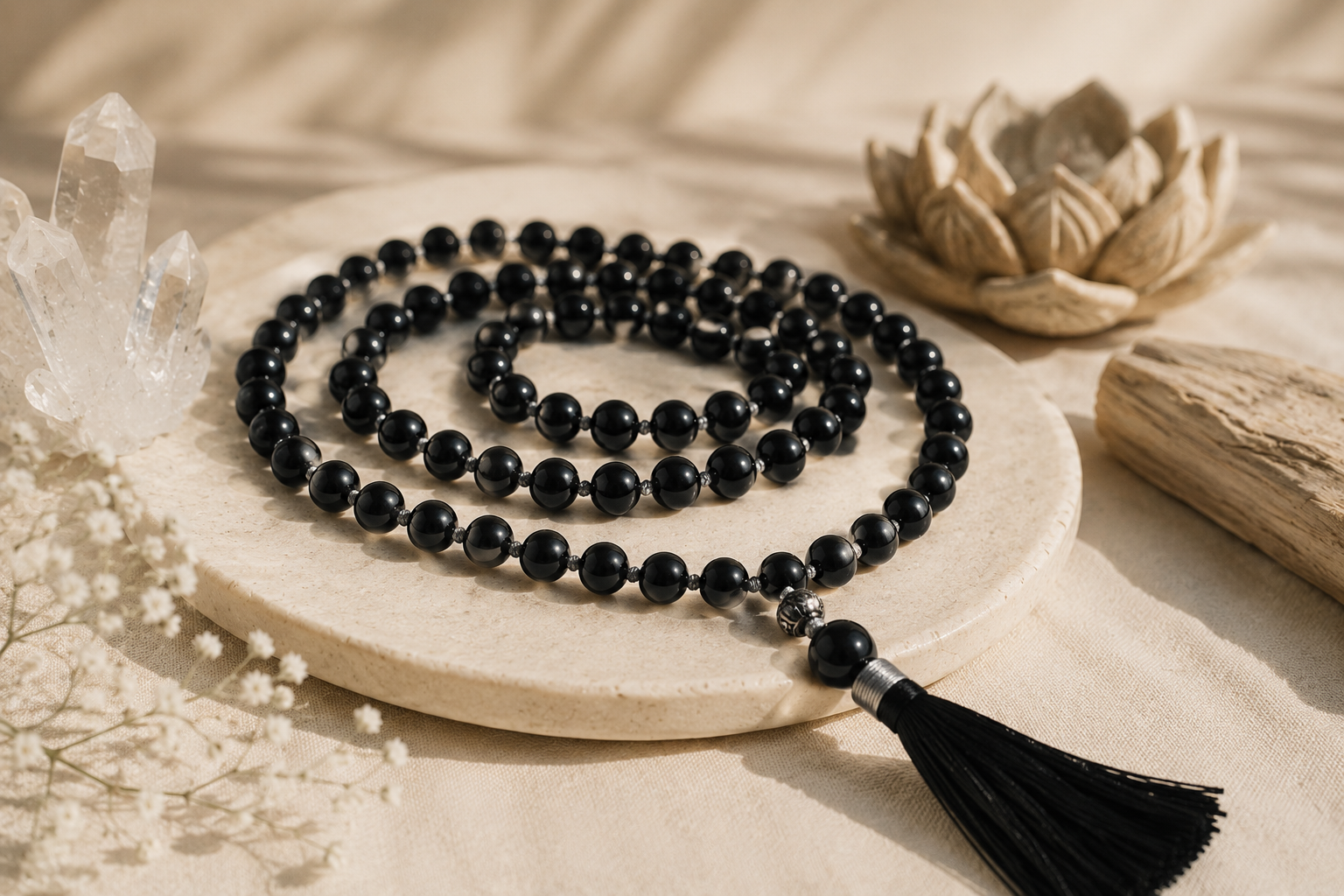
Anyone who has picked up a mala for meditation or mantra practice has likely noticed the number of beads strung along its length. With rare exception, a traditional japmala contains 108 beads, plus an additional guru bead that sits outside the counting sequence. This number is not arbitrary, nor is it a recent invention. It carries centuries of mathematical curiosity, spiritual symbolism, and cultural significance that stretches across multiple traditions.
One of the more striking things about 108 is how often it appears across seemingly unrelated systems of thought. In Hindu and Buddhist traditions, the number shows up repeatedly, from the 108 names or epithets attributed to various deities to the 108 Upanishads referenced in some classical texts. In Japanese Buddhist practice, temple bells are traditionally rung 108 times on New Year’s Eve, a custom known as joya no kane, said to represent the 108 earthly desires or afflictions that practitioners hope to release as the year turns.
Beyond religious texts, 108 has also drawn attention from those interested in astronomy and mathematics. Some point out that the average distance from the Earth to the Sun is roughly 108 times the Sun’s diameter, and the average distance from the Earth to the Moon is roughly 108 times the Moon’s diameter. Whether these astronomical observations directly influenced the adoption of 108 as a sacred number, or whether they represent a kind of retrospective pattern-finding, remains a matter of some debate among historians. What seems clear is that ancient astronomers and mathematicians in South Asia were engaged in sophisticated observation and calculation, and the recurrence of 108 across their calculations may not be entirely coincidental.
Mathematically, 108 is the product of one, zero, and eight when considered individually, but its more commonly cited factorization is 9 × 12. Both nine and twelve carry their own symbolic weight in various traditions. Nine has long been associated with completion or fulfillment in numerology, sometimes linked to the nine planets recognized in traditional Vedic astrology, known as the Navagraha. Twelve appears prominently as well, echoed in the twelve houses of the zodiac, the twelve months of the year, and various other cyclical systems.
Some scholars of Vedic mathematics and cosmology have also pointed to 108 as a number that emerges from more complex numerological formulas involving the digits one, zero, and eight individually, each said to carry its own symbolic meaning. The digit one is sometimes associated with unity or the divine, zero with emptiness or the void from which all things arise, and eight with infinity, given its resemblance to the mathematical symbol for infinity when turned on its side. Put together, the number becomes a kind of numerical expression of the relationship between unity, emptiness, and infinity, though it is worth noting that this interpretation is one among several offered across different teachers and lineages, rather than a single universally agreed upon explanation.
In practical terms, the 108-bead japmala serves a fairly straightforward purpose. It gives the practitioner a physical way to track repetitions of a mantra without needing to consciously count in the mind, which might otherwise interrupt the flow of meditation. Each bead is moved between the thumb and middle finger as a mantra is recited or a breath is taken, allowing the practitioner to complete one full cycle, sometimes called a mala, upon returning to the starting point near the guru bead.
Tradition generally holds that the guru bead itself is not counted as part of the 108 and should not be crossed over during practice. Instead, upon reaching the guru bead at the end of a cycle, some traditions suggest turning the mala around rather than continuing past it, then moving in the opposite direction for the next round if additional repetitions are desired. This small gesture is sometimes described as a way of honoring the teacher or the lineage from which the practice originates, though practices vary depending on the specific tradition being followed.
The repetitive nature of counting through 108 beads is thought to support a kind of meditative rhythm, allowing the mind to settle into the mantra rather than becoming distracted by tracking numbers. Over time, many practitioners report that the physical sensation of the beads moving through their fingers becomes deeply associated with the mental and emotional state cultivated during practice, creating a kind of embodied shorthand for stillness.
While 108 remains the most widely recognized count, it is not universal across every tradition that uses prayer or meditation beads. Tibetan Buddhist malas, for instance, sometimes include additional counter beads or a slightly different structure depending on the specific practice they are intended for. Some Japanese Buddhist prayer beads, known as juzu or nenju, may use shorter counts such as 27 or 54, often described as fractions of the full 108, adapted for practical convenience.
Islamic prayer beads, known as tasbih or misbaha, commonly use a count of 99, corresponding to the 99 names of Allah recognized in Islamic tradition, sometimes divided into three sets of 33. While this is a distinct tradition with its own history and meaning, the parallel use of beads for counting sacred repetitions across such different religious and cultural contexts speaks to a broader human tendency to use physical objects as anchors for spiritual practice.
For those new to mala practice, selecting a mala often involves more than simply counting beads. Material matters a great deal to many practitioners, with options ranging from rudraksha seeds, associated in some traditions with Lord Shiva, to various gemstone malas believed to carry particular energetic properties, to sandalwood malas, valued for their calming scent and connection to certain Buddhist and Hindu practices. There is no single correct material, and many practitioners find that their preferences shift depending on the specific intention or mantra they are working with at a given time.
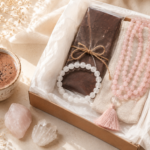
Caring for a mala often becomes its own small ritual. Some practitioners keep their mala wrapped in a cloth pouch when not in use, both as a practical measure to protect the beads and as a gesture of respect toward the object. Others choose to cleanse their mala periodically, whether through smoke, moonlight, or simply setting an intention of renewal, particularly if the mala has been used during a period of difficulty or emotional processing.
It is worth acknowledging that the deeper mathematical and astronomical explanations for 108, while genuinely fascinating, may matter less to many practitioners than the simple fact of consistency. Having a fixed, known count allows the mind to release the burden of tracking and instead settle into the practice itself. Whether a person is drawn to the number because of its astronomical resonance, its numerological symbolism, or simply because it has been the standard for so many centuries across so many traditions, the effect on practice tends to be similar. The bead count becomes a container, a known structure within which something more difficult to measure, namely presence and attention, can unfold.
For those beginning a japmala meditation practice, it may be worth spending some time researching which tradition or lineage feels most resonant before selecting a mala, since the meaning attached to the practice can shape the experience as much as the object itself.
If you would like to begin or deepen your meditation practice, explore our collection of 108-bead japmalas, handcrafted to support mantra meditation, mindfulness, and intentional daily rituals.

Our offerings—ceremonial cacao, crystals, candles, and journals—are designed to support mindfulness, self-connection, and sacred daily rituals. Every product is ethically sourced, handcrafted with care, and infused with meaning to help you slow down, tune in, and create moments of presence.
© 2025 All rights reserved Conscious Collective